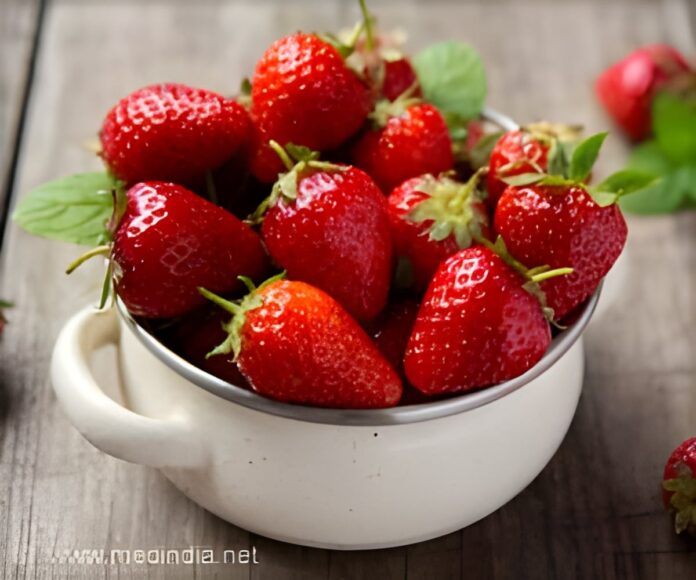
How long can strawberries stay fresh without refrigeration? A new edible coating made from seaweed helped slow mould growth, moisture loss and spoilage.
A thin edible coating made from seaweed could help strawberries stay fresh at room temperature for at least four days, according to researchers at the University of British Columbia. ()
The coating is made from agar, a substance derived from red seaweed, combined with zinc and tannic acid. Researchers found that treated strawberries lost less water, stayed firmer and resisted mold longer than untreated fruit. The findings were published in the Journal of Agricultural and Food Chemistry.
How the Seaweed Coating Works
The researchers used agar, which is already widely used in food products as a thickener and a plant-based alternative to gelatin. When agar was combined with zinc and tannic acid, the ingredients formed tiny particles that assembled into a thin protective layer around the fruit.
The coating dries clear and is edible. It acts as a barrier that slows moisture loss, one of the main reasons fresh strawberries soften and deteriorate after harvest. Researchers tested the coating on strawberries, grapes and apple slices. The results were strongest for strawberries, which were able to remain mold-free for at least four days at room temperature.
Coated Strawberries Stayed Fresh Longer
In the four-day test, coated strawberries lost less than half as much water as untreated berries. They also remained firmer and retained more vitamin C and antioxidants. Untreated strawberries kept at room temperature began developing mold after about two days. Refrigeration extended their freshness, but most untreated berries stored in the refrigerator began deteriorating by around the fourth day.
The coated strawberries, however, remained mold-free for at least four days without refrigeration. Refrigerated coated strawberries remained fresh for at least six days. The treatment also showed effects on other produce. Coated grapes maintained improvements for up to 14 days, while coated apple slices showed benefits for about 24 hours.
Could the Coating Reduce Food Waste?
The researchers say the technology could have applications beyond keeping fruit fresh at home. Fresh produce requires refrigeration during much of its journey from farms to warehouses, trucks, shops and consumers. Keeping those temperatures stable requires electricity, equipment and transport infrastructure.
The UBC team found that the coating had a carbon footprint 14% lower than conventional refrigeration in its life-cycle assessment. It also reduced freshwater ecotoxicity by about 85%, largely because less refrigeration was required. For the food industry, a treatment that slows spoilage without depending entirely on continuous refrigeration could potentially reduce losses during storage and transportation.
Is the Coating Safe to Eat?
The researchers used food-grade materials and found no signs of toxicity in tests involving human intestinal cells. Most of the coating could also be washed off with tap water within about two minutes for consumers who do not want to eat it.
However, the technology is still at the research stage. The team is testing the coating on other fruits and vegetables and studying how it could be produced and used at commercial scale. The researchers also replaced laboratory-grade agar with commercially available food-grade agar during testing and found similar results, an important step toward potential real-world use.
What the Research Means for Fresh Produce
The study does not mean refrigeration could immediately be replaced by the coating. Commercial supply chains involve longer storage periods, changing temperatures, transportation conditions and large volumes of produce. But the findings show that an edible coating made from a familiar seaweed-derived ingredient can slow some of the processes that cause fresh fruit to deteriorate.
If the approach performs consistently in larger-scale testing, it could offer food producers another way to extend shelf life, reduce spoilage and lower the amount of refrigeration needed to keep fresh produce in good condition.
References:
- UBC seaweed-derived coating keeps strawberries fresher than a fridge – (https://news.ubc.ca/2026/08/ubc-seaweed-coating-keeps-strawberries-fresher-than-a-fridge)
Source-Medindia