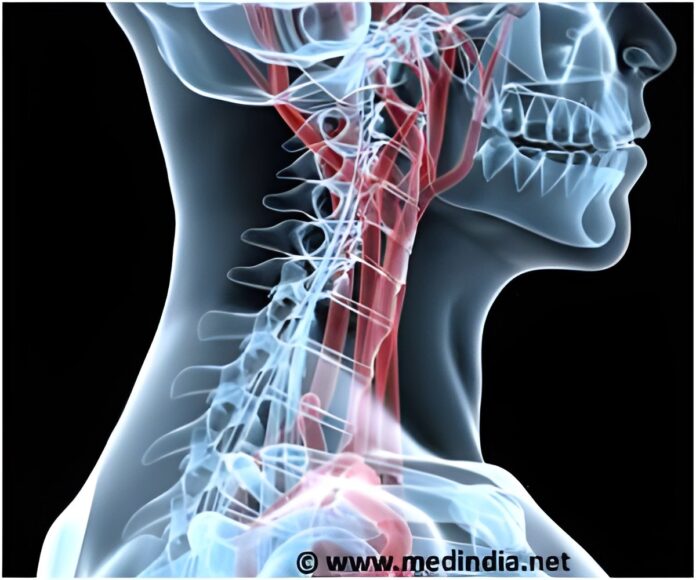
AI analyzes audio features such as pitch, amplitude variation, and tonal to noise ratio for recognizing vocal fold cancer.
Early screening with scheduled diagnosis can improve patient outcomes in cancer. To date, laryngeal cancers are diagnosed using painful invasive procedures like nasal endoscopy and biopsies. Voice box abnormalities can be identified via sound analysis using Artificial Intelligence (AI) models, showed by recent research published in Frontiers in Digital Health (1✔ ✔Trusted Source
Voice as a Biomarker: Exploratory Analysis for Benign and Malignant Vocal Fold Lesions
Go to source
).
Some vocal fold lesions such as polyps (tissue growths) may be benign but they act as early warning signs of laryngeal cancer. Powerful AI tools can uncover these early stages from simple voice recordings.
“Here we show that with this dataset we could use vocal biomarkers to distinguish voices from patients with vocal fold lesions from those without such lesions,” said Dr. Phillip Jenkins, a postdoctoral fellow in clinical informatics at Oregon Health & Science University, and the study’s corresponding author.
Acoustic Features were Analyzed Among Different Participants
Scientists analyzed variations in tone, pitch, volume, and clarity with 12,523 voice recordings of 306 participants from across North America. A minority were from patients with known laryngeal cancer, benign vocal fold lesions, or two other conditions of the voice box: spasmodic dysphonia and unilateral vocal fold paralysis.
The researchers focused on differences in several acoustic features of the voice:
- Fundamental frequency (mean pitch)
- Jitter (pitch variation)
- Shimmer (amplitude variation)
- Harmonic-to-noise ratio (tonal and noise balance in speech)
Notable differences in harmonic-to-noise ratio and fundamental frequency were found across three groups of male participants:
- Healthy men
- Men with benign vocal fold lesions
- Men with laryngeal cancer
No informative acoustic features were detected among women, but it is possible that a larger dataset would reveal such differences.
“Our results suggest that ethically sourced, large, multiinstitutional datasets like Bridge2AIVoice could soon help make our voice a practical biomarker for cancer risk in clinical care,” said Jenkins.
The Next Phase is to Use Algorithms on Larger Datasets
“To move from this study to an AI tool that recognizes vocal fold lesions, we would train models using an even larger dataset of voice recordings, labeled by professionals. We then need to test the system to make sure it works equally well for women and men,” said Jenkins.
Advertisement
“Voice-based health tools are already being piloted. Building on our findings, I estimate that with larger datasets and clinical validation, similar tools to detect vocal fold lesions might enter pilot testing in the next couple of years,” predicted Jenkins.
Reference:
- Voice as a Biomarker: Exploratory Analysis for Benign and Malignant Vocal Fold Lesions – (https://www.frontiersin.org/journals/digital-health/articles/10.3389/fdgth.2025.1609811/full)
Source-Eurekalert