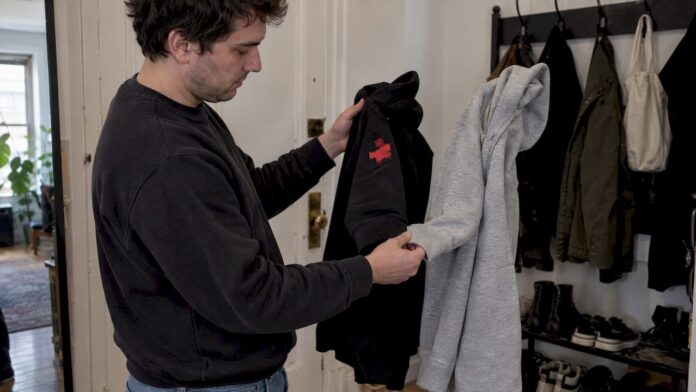
A heavyweight hoodie is warmer, more structured and built to hold its shape. A lightweight hoodie is easier to layer, easier to carry and more comfortable when you are moving or indoors. Neither is better across the board. The right one depends on where you will wear it, how active you will be and how much you want the fabric to stand up on its own. This guide gives you the numbers, the trade-offs and a simple way to decide, including the middle option, midweight, that most shoppers end up asking about.
TL;DR
- Lightweight is roughly 200–280 GSM (7–10 oz/yd²), midweight roughly 280–350 GSM (10–12 oz/yd²) and heavyweight 350 GSM and up (12–18 oz/yd²), according to one 2025 hoodie weight guide. Brands draw these lines differently, so compare the actual number.
- Choose heavyweight for standing or sitting in cold air and for a structured look. Choose lightweight or midweight for walking, layering, travel and mild weather.
- Weight describes the fabric, not the fit. A heavyweight hoodie can be slim, and a lightweight one can be oversized. Check the size chart.
- Fiber, knit and interior finish change how a hoodie feels as much as weight does. Read the whole spec, then the care label.
Table of Contents
What the weight numbers actually mean
Hoodie weight is a measure of the fabric, not the finished garment. You will see it listed two ways: GSM (grams per square meter) and oz/yd² (ounces per square yard). They describe the same thing in different units, which is why a tag can say 8 oz while a competing listing says 270 GSM for a similar fabric.
Here are the ranges from a 2025 guide to hoodie weight categories:
| Category | GSM | Fabric oz/yd² | Best for |
|---|---|---|---|
| Lightweight | 200–280 | 7–10 | Layering, travel, mild weather, indoors |
| Midweight | 280–350 | 10–12 | Everyday wear across most of the year |
| Heavyweight | 350+ | 12–18 | Cold weather, structure, a premium feel |
Two cautions go with that table. First, those cut-offs are one source’s convention. Other apparel guides place common hoodie fabric around 280–340 GSM and describe premium heavyweight examples at roughly 320–380 GSM, with the thickest reaching 400–500 GSM, as Gymshark’s heavyweight roundup does. A hoodie one brand calls heavyweight might be another brand’s midweight.
Second, always check which weight is being quoted. Some listings give the fabric weight, and others give the weight of the whole garment. A shopper who sees “8.5 oz” on a listing is almost certainly looking at fabric weight, which under the guide above falls in the lightweight range, not the heavyweight one. If the listing does not say, ask or look for a spec line.
Fabric weight versus garment weight
The finished hoodie also has a weight on a scale. The same guide estimates lightweight hoodies at about 0.8–1.2 lb, midweight at 1.3–1.8 lb and heavyweight at 1.8–2.5 lb or more. Treat those as rough guides. Size, fiber, hood construction, lining, zipper and pockets all move the number. A size XXL zip hoodie in a midweight fabric can outweigh a small heavyweight pullover.
Heavyweight hoodies: what you gain and what you give up
Heavier fabric traps more air and blocks more wind, so it tends to feel warmer when you are not moving. It also holds its shape. That is why heavyweight hoodies read as more premium: the hem stays put, the sleeves do not collapse and the body hangs with a defined silhouette.
Where heavyweight wins
- Cold days when you are mostly stationary: a late-season outdoor event, a sideline, a stoop, a long wait for a bus.
- A visible statement piece. Heavier, more structured fabric gives large artwork a steadier surface and a more defined silhouette, according to a hoodie comparison from Guarded Apparel.
- Repeat wear. Dense fabric usually looks better for longer, as long as you follow the care label.
What you give up
- Packability. A heavyweight hoodie takes up real room in a bag.
- Drying time. Thick cotton-heavy fabric takes noticeably longer to dry.
- Flexibility across seasons. In an overheated subway car or a classroom, it can be too much.
- Price. Heavier fabric costs more to make, so heavyweight styles often cost more.
Lightweight hoodies: the easy layer
A lightweight hoodie is the one you throw in a tote and forget about until the air conditioning kicks in. It breathes better, moves with you and sits comfortably under a jacket or over a tee.
Where lightweight wins
- Layering. Less bulk means it slides under a coat without bunching at the shoulders.
- Travel and commuting. It folds small and dries faster.
- Mild weather, spring and fall evenings, and indoor spaces where you want a bit of coverage rather than serious warmth.
- Active days. If you are walking across a city, a lighter layer vents heat more easily.
What you give up
- Real cold-weather warmth. You will need another layer once the temperature really drops.
- Structure. Lighter fabric drapes softly, which some people love and others find too limp for a graphic piece.
Where midweight fits
People searching for midweight vs heavyweight are usually trying to avoid choosing an extreme. Midweight, roughly 10–12 oz/yd² by the guide above, is the hoodie most people can wear across most of the year. It is warm enough for a chilly morning and still forgiving when you walk, commute or step indoors. If you can own only one hoodie and you live somewhere with real seasons, midweight is the safe pick. Go heavy when your main use is cold and still, and go light when your main use is layering or mild weather.
Does heavyweight mean oversized?
No. This is one of the most common mix-ups. Weight describes the fabric. Oversized describes the cut and pattern. A heavyweight hoodie can be slim, regular, relaxed or oversized, and a lightweight hoodie can also be cut boxy and loose.
The confusion happens because heavier fabric holds a boxy shape so well that oversized heavyweight hoodies dominate the streetwear scene. But the label on the size tag is what decides the fit, not the GSM. Before you buy:
- Find the garment’s measurement chart.
- Compare chest width, body length, shoulder width and sleeve length with a hoodie you already own and like.
- Decide whether you want the sleeves and hem to sit snug or loose.
- Size up or down based on those numbers, not on the word “heavyweight.”
We wrote a step-by-step hoodie size guide for exactly this, and it pairs well with the weight decision.
Warmth is more than weight
It is tempting to treat GSM as a warmth score. It is a good first filter, but only a first one. Textile research makes this clear: a study of knitted fabrics from the NC State textile journal tested cotton and cotton/elastane knits and found significant differences between fabric types in thermal, permeability, wicking, thickness and shrinkage properties. In other words, fiber content and knit structure matter, not just the number of grams.
What that means for you in practice:
- Interior finish. A brushed fleece interior feels plush and traps warmth. French terry has a looped interior that can allow more air exchange, which is why a French terry hoodie often feels more comfortable in changing temperatures.
- Fiber blend. Cotton feels soft and breathes, polyester adds durability and dries faster, and blends split the difference. Check the label.
- Construction. Ribbing at the cuffs and hem keeps warmth in. Strong seams and a well-built hood help a hoodie last.
- Fit. A snug hoodie traps more warm air than a very loose one of the same weight.
If you want to go further on the fleece side, our guide to fleece types explains how the different interiors behave for travel, layering and advocacy wear.
Match the hoodie to what you will be doing
The best way to decide is to think about activity, not just season. A walk, a commute or a day on your feet generates heat, so a lighter layer is usually more comfortable and easier to adjust. Sitting or standing still in cold air is a different story. That is when heavyweight earns its place.
| Your situation | Weight to consider | Why |
|---|---|---|
| Walking around the city in fall | Lightweight or midweight | Vents heat, layers under a coat |
| Watching an outdoor event in late fall | Heavyweight | You are stationary, so warmth matters most |
| Classroom, office or panel with strong air conditioning | Lightweight | Light cover without overheating |
| Flying or packing carry-on | Lightweight | Folds small |
| Winter weekends, errands, dog walks | Midweight or heavyweight | Comfort across the day |
| Gift for someone who wears hoodies daily | Midweight | Works in most conditions |
Also think about layering. If you plan to wear the hoodie under a coat, a lighter fabric reduces bulk. If it is the outer layer, heavier fabric can do the job alone.
Pullover or zip
Weight and closure interact. A zip-up lets you vent heat quickly, which suits lighter and midweight fabrics, while a pullover keeps a cleaner front for artwork. Our guide to choosing between a pullover and a zip hoodie walks through seven checks.
Hoodie or crewneck
If you mostly like thick fabric but not the hood, a heavy crewneck is another option. We compare the two in crewneck vs hoodie for style shoppers.
Choosing a hoodie to wear a message
When the hoodie carries an advocacy message, weight takes on another job. Heavier, more structured fabric gives large artwork a steadier surface, so a graphic keeps its shape. Lightweight fabric is easier to wear in places where you will be indoors and moving: classrooms, events, travel days.

A simple rule: pick a heavyweight outer layer if you want the message to be seen from across a cold street, and a lighter layer if you want it to travel easily and live in your bag.
Caring for the weight you choose
Heavyweight does not mean indestructible. The National Institute of Standards and Technology lists fiber, fabric structure, finish, construction and washing and drying methods as the factors behind wash-and-wear performance. A thick hoodie can still shrink, fade or lose its hand feel if it is washed hot and dried on high.
Practical habits that work for either weight:
- Read the care label before the first wash.
- Turn the hoodie inside out to protect printed artwork.
- Use cold water and a gentle cycle.
- Skip high heat in the dryer, and give heavyweight pieces extra time to dry fully.
For the detail, see our guide to washing hoodies without shrinkage or fading. Another useful read on cold-water, gentle-cycle washing to preserve fit and prints covers the same ground from a different angle.
Our perspective
We make hoodies and sweatshirts to start conversations, so we think about how people actually wear them. Many of the people who wear our designs are advocates, people living with a mental health condition, students, clinicians and allies. They wear the message at rallies, panels, classrooms, appointments and on the train. A single weight does not fit all of that.
Our view is that the best hoodie is the one you will actually put on. A very heavy hoodie that stays in the closet from April to October does less for awareness than a comfortable one you wear weekly. If you are buying for yourself, think about the place where you will wear it most. If you are buying for someone else, midweight is usually the kinder choice, because it works in more rooms and more months.
We also care about fabric stability. A message is easier to read when the shirt does not wrinkle around it, and a hoodie that keeps its shape lets the artwork do its work. That is one reason we pay attention to how a fabric holds up, not just how it looks on day one.
Do not let the word “heavyweight” push you toward more than you need. Ask what the spec says, check the size chart and think about the weather you will really face.
— Michelle
Find your hoodie
If you are ready to choose, our mental health hoodies and sweatshirts bring original artwork by Michelle Hammer, a schizophrenia activist, to wearable pieces. You can browse designs such as Define Normal, Blue Rorschach and Keep Going. Check each product page for its details before you order.
A quick checklist before you buy
- Find the number. Look for GSM or oz/yd², and confirm whether it is fabric or garment weight.
- Think about use. Moving, layering and indoors point lighter. Still, cold and outdoors point heavier.
- Check the interior. Brushed fleece for warmth, looped French terry for more airflow.
- Read the fiber content. Blends and cotton behave differently in warmth and in the wash.
- Use the size chart. Do not infer fit from weight.
- Plan for care. Follow the label, wash cold and dry gently.
- Consider the closet. If you own a heavy coat, a lighter hoodie may be more useful than a third heavy layer.
FAQ
What is considered heavyweight for a hoodie?
In one 2025 guide, heavyweight starts around 350 GSM, or 12 oz/yd². Other guides place premium examples at roughly 320–380 GSM, with the thickest at 400–500 GSM. Because brands define the category differently, compare the actual number on the listing.
Does heavyweight mean oversized?
No. Weight is about the thickness of the fabric, and oversized is about the cut. Heavyweight hoodies come in slim, regular, relaxed and oversized fits, so check the measurement chart rather than guessing from the GSM.
Is 8.5 oz heavy for a sweatshirt?
Usually not. Under the 2025 guide above, 8.5 oz/yd² sits in the lightweight range of 7–10 oz/yd². Confirm that the figure is fabric weight and not the weight of the finished garment, since listings use different conventions.
Is a heavyweight hoodie always warmer?
Usually, but not always. Fiber, knit structure and interior finish also affect warmth and breathability, as textile research on knitted fabrics shows. Judge the whole fabric, not only the GSM.
Should I pick midweight if I cannot decide?
For most people, yes. Midweight handles a wide range of temperatures and activities, and it layers more easily than heavyweight. Go heavier only if you will mostly be standing or sitting in cold air.
Sources
Recommended
Comments