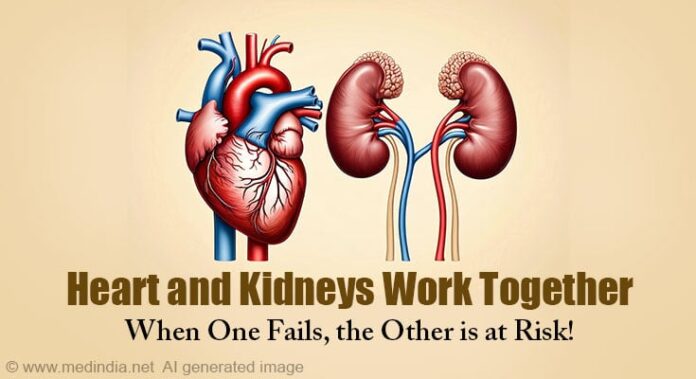
A global expert report highlights the strong and often overlooked connection between heart failure and chronic kidney disease.
- Heart failure and chronic kidney disease frequently occur together.
- Early diagnosis and coordinated care are essential.
- New treatments such as SGLT2 inhibitors are improving outcomes for both conditions.
Heart failure and chronic kidney disease (CKD) are among the leading causes of illness worldwide, and doctors increasingly recognize that the two conditions are closely connected.
A recent KDIGO Controversies Conference report, published in JACC: Heart Failure, reviewed the latest research and concluded that heart failure and kidney disease frequently occur together and significantly increase the risks of hospitalization, disease progression, and death.
The report emphasizes that patients with both conditions require coordinated care involving cardiologists and nephrologists. (1✔ ✔Trusted Source
Kidney disease and heart failure: recent advances and current challenges: conclusions from a Kidney Disease: Improving Global Outcomes (KDIGO) Controversies Conference
Go to source)
How Heart and Kidney Disease Affect Each Other
The interaction between the kidney and the heart is commonly referred to as cardiorenal syndrome (happens when a dysfunction in one organ causes dysfunction in the other).
For example, heart failure may decrease blood flow to the kidneys and the ability of the kidneys to filter waste products and balance fluid.
Kidney problems may lead to fluid build-up, hypertension and changes in metabolism, further overloading the heart.
This is a two-way process; that is why patients with one condition are highly vulnerable to the other. (2✔ ✔Trusted Source
Cardiorenal syndrome
Go to source)
Heart Failure and Kidney Disease Shared Risk Factors
Some of the well-known chronic conditions that predispose to heart failure and kidney disease are:
Such risk factors provoke inflammation, vascular damage, and changes in hormones, which occur in organs at the same time.
Due to these common causes, professionals have now highlighted the increased focus on the cardiovascular-kidney-metabolic health approach to prevention and treatment.
Why Heart Failure is Hard to Diagnose in Patients with Kidney Disease
The problem is that heart failure may be hard to diagnose in patients with kidney disease since most of the symptoms are similar.
Common symptoms include:
- Shortness of breath
- Leg swelling
- Fatigue
- Fluid retention
Physicians use some tests to identify the conditions:
- Kidney functioning examinations (creatinine, eGFR)
- Urine tests for albumin
- Cardiac labelling, e.g., echocardiography.
- Biomarkers such as BNP
However, the interpretation of certain biomarkers may be difficult owing to the fact that kidney disease may elevate their levels in itself.
Why Small Changes in Kidney Tests May Not Always Be Dangerous
The KDIGO report highlights an important clinical insight: some medications used to treat heart failure can cause small changes in kidney function tests.
A mild increase in blood creatinine after starting treatment may reflect hemodynamic changes rather than permanent kidney damage, and doctors often continue therapy if the changes remain stable. recent
Understanding this effect helps prevent premature discontinuation of beneficial therapies.
New Treatments That Benefit Both Heart and Kidneys
The new developments in medicine have enhanced the therapeutic choices of patients with heart disease and kidney disease.
SGLT2 inhibitors are one type of drug that is useful in the treatment of heart failure and chronic kidney disease, as well as in the management of diabetes.
These drugs have been shown in large clinical trials to decrease heart failure hospitalisations and slow the progression of kidney disease. (3✔ ✔Trusted Source
SGLT-2 Inhibitors in Heart Failure: A Review of Current Evidence
Go to source)
Other commonly used therapies include:
- ACE inhibitors
- Angiotensin receptor blockers (ARBs)
- Mineralocorticoid receptor antagonists
- Angiotensin receptor–neprilysin inhibitors (ARNI)
Experts say these therapies represent a growing convergence between heart and kidney treatments.
Lifestyle Changes to Prevent Heart and Kidney Damage
In addition to medications, lifestyle changes play a crucial role in protecting heart and kidney health.
Important measures include:
- Maintaining healthy blood pressure
- Controlling diabetes
- Staying physically active
- Maintaining a healthy weight
- Moderating sodium intake
These measures help reduce strain on both organs and lower the risk of complications.
Frequently Asked Questions
Q: What is cardiorenal syndrome?
A: Cardiorenal syndrome describes a condition in which heart and kidney dysfunction occur together, with each organ worsening the function of the other. cardiorenal
Q: Why are heart and kidney diseases connected?
A: The heart pumps blood to the kidneys, and the kidneys regulate fluid balance and blood pressure. When one organ fails, it can disrupt the function of the other.
Q: Can kidney disease increase the risk of heart failure?
A: Yes. Chronic kidney disease can cause high blood pressure, fluid overload, and metabolic changes that increase strain on the heart.
Q: Are there medicines that treat both conditions?
A: Yes. Medications such as SGLT2 inhibitors, ACE inhibitors, and ARBs have been shown to benefit both heart and kidney health. sglt2
Q: Can lifestyle changes help prevent both diseases?
A: Yes. Controlling blood pressure, managing diabetes, maintaining a healthy diet, and regular exercise can reduce the risk of both heart failure and kidney disease.
References:
- Kidney disease and heart failure: recent advances and current challenges: conclusions from a Kidney Disease: Improving Global Outcomes (KDIGO) Controversies Conference – (https://pubmed.ncbi.nlm.nih.gov/41791738/)
- Cardiorenal syndrome – (https://pubmed.ncbi.nlm.nih.gov/19007588/)
- SGLT-2 Inhibitors in Heart Failure: A Review of Current Evidence – (https://pmc.ncbi.nlm.nih.gov/articles/PMC10172076/)
Source-Medindia