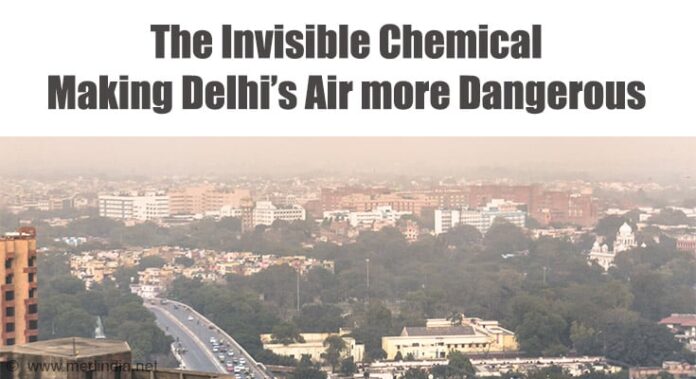
A Harvard-led study reveals that ammonium sulfate makes up nearly one-third of Delhi’s PM2.5 pollution. Here’s what it is, how it forms, and why it’s especially harmful to human health.
- Nearly one-third of Delhi’s PM2.5 pollution comes from an invisible chemical called ammonium sulfate
- This pollutant forms in the air through reactions, not direct emissions, making it harder to control
- Ammonium sulfate–rich smog may worsen lung and heart disease, especially during winter months
A major new study involving researchers from Harvard University and the Centre for Research on Energy and Clean Air (CREA) has uncovered a troubling truth about Delhi’s air pollution: nearly one-third of the city’s PM2.5 pollution is ammonium sulfate, a harmful particle that doesn’t come directly from exhaust pipes or chimneys (1✔ ✔Trusted Source
A satellite-driven model to estimate long-term particulate sulfate levels and attributable mortality burden in China
Go to source
).
Instead, it forms silently in the air through chemical reactions, making Delhi’s smog more complex, persistent, and dangerous than previously understood.
During peak pollution months, especially after the monsoon and throughout winter, ammonium sulfate can account for as much as 49% of PM2.5, according to the study. Even in winter alone, it accounts for about 41%. This means the haze people breathe isn’t just visible dust or smoke, but also invisible chemistry unfolding overhead.
TOP INSIGHT

Did You Know?
Delhi’s smog isn’t just smoke and dust – it’s chemistry happening in the air, quietly worsening health risks. #delhismog #airpollutionindia #pm25 #publichealth #respiratoryhealth #medindia
What Is Ammonium Sulfate and How Does It Form?
Ammonium sulfate is what scientists refer to as a secondary inorganic aerosol. Unlike pollution that is directly emitted, it forms inside the atmosphere.
Here’s how it happens:
- Sulfur dioxide (SO₂) is released from coal-fired power plants, industries, and diesel engines
- Ammonia (NH₃) mainly comes from agricultural activities, fertilisers, and animal waste
- When these gases mix in cool, humid conditions, they react and form ultrafine ammonium sulfate particles
These particles are smaller than 2.5 micrometres, allowing them to remain suspended in the air for long periods and travel deep into the lungs when inhaled.
Why Delhi’s PM2.5 Problem Is Worse Than It Looks
For years, pollution control strategies have focused on visible sources, such as traffic exhaust, construction dust, and crop burning. This study shows that a significant part of the problem comes from chemical reactions that occur after emissions are released.
That means reducing visible pollution alone is not enough. Unless the gases that trigger these reactions, especially sulfur dioxide and ammonia, are controlled, PM2.5 levels will remain dangerously high (2✔ ✔Trusted Source
Large share of India’s PM2.5 not emitted directly, but chemically formed in the atmosphere: CREA Study
Go to source).
This isn’t unique to Delhi. Across India, secondary particles, such as ammonium sulfate, contribute 17% to 42% of PM2.5, depending on the region.
How Harmful Is Ammonium Sulfate to Human Health?
PM2.5 is already known to be one of the most dangerous forms of air pollution because it can penetrate deep into the lungs and even enter the bloodstream. Emerging evidence suggests that ammonium-rich particles may be particularly harmful.
Health impacts linked to ammonium sulfate–heavy pollution include:
Doctors in Delhi consistently report spikes in breathing problems, chest tightness, and cardiovascular complaints during high-smog periods — and this study helps explain why.
Why This Matters for Everyday Life in Delhi
For residents, especially during winter, daily activities like commuting, outdoor exercise, or children walking to school carry hidden risks. The danger isn’t limited to coughing or eye irritation. Long-term exposure can affect heart health, lung development in children, and overall life expectancy.
Vulnerable groups, children, the elderly, pregnant women, and people with existing lung or heart disease are especially at risk during high ammonium sulfate days.
What Can Be Done to Reduce the Risk?
At a policy level, experts stress the need to curb the precursor gases that lead to ammonium sulfate formation. Measures such as installing flue-gas desulfurization units in power plants can significantly reduce sulfur dioxide emissions and prevent secondary particle formation.
At an individual level, people can reduce exposure by:
- Using certified indoor air purifiers
- Wearing high-quality masks on severe pollution days
- Limiting outdoor activity during peak smog hours
- Supporting policies that address both visible pollution and invisible chemical pollutants
The Bottom Line
Delhi’s air pollution crisis isn’t just about what we can see. A large part of the danger comes from invisible chemical reactions happening in the air, quietly forming particles that harm the lungs and heart.
Understanding ammonium sulfate shifts our perspective on smog control. Cleaning Delhi’s air will require tackling not just smoke and dust, but the chemistry that turns everyday emissions into a serious public health threat.
Frequently Asked Questions
Q: Is ammonium sulfate regulated under India’s air quality standards?
A: Currently, air quality standards regulate PM2.5 as a whole, not individual components like ammonium sulfate, making this pollutant harder to target directly.
Q: Can indoor air purifiers remove ammonium sulfate particles?
A: Yes. HEPA-certified air purifiers can effectively filter PM2.5 particles, including ammonium sulfate, when used correctly indoors.
Q: Why does ammonium sulfate increase more in winter?
A: Cool temperatures and high humidity during winter create ideal conditions for sulfur dioxide and ammonia to react and form ammonium sulfate.
Q: Does wearing a regular cloth mask protect against ammonium sulfate?
A: No. Only well-fitted N95 or equivalent masks can significantly reduce inhalation of PM2.5 particles.
Q: Are children more affected by ammonium sulfate–rich pollution?
A: Yes. Children breathe faster, have developing lungs, and are more vulnerable to fine particles that penetrate deep into the respiratory system.
References:
- A satellite-driven model to estimate long-term particulate sulfate levels and attributable mortality burden in China – (https://pmc.ncbi.nlm.nih.gov/articles/PMC9985485/)
- Large share of India’s PM2.5 not emitted directly, but chemically formed in the atmosphere: CREA Study – (https://www.downtoearth.org.in/air/large-share-of-indias-pm25-not-emitted-directly-but-chemically-formed-in-the-atmosphere-crea-study)
Source-Medindia