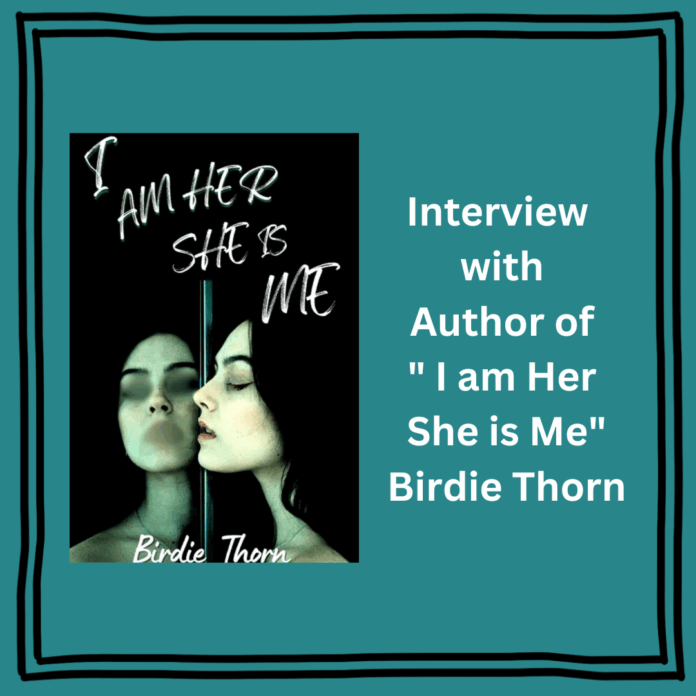
Birdie Thorn is an Author and Mental Health Advocate. She is a speaker with the National Alliance on Mental Illness. She has written articles for the International Bipolar Foundation. Birdie has lived experience with Bipolar 2, Generalized Anxiety Disorder, and ADHD. Birdie runs an Instagram page @birdies.bipolar.brain that brings awareness to mental health conditions.
Q: What inspired you to write the book, I Am Her She Is Me?
A: I live with Bipolar 2 disorder. There have been so many times that I wished my thoughts would play out like a movie for those around me so that they could get an understanding of what it is like inside my head. I wrote the book in first person so that I could do exactly what I wanted to do with my own mental health condition. I give people a first-hand look at the deepest depths of depression and the heights of mania.
Q: Is, I Am Her She Is Me, based on a true story?
A: The book is fiction but has many parts that are inspired by true events or real people. There are some parts of the book that are describing a depressive episode that the main character is experiencing. Those parts are often straight out of my own journals describing my personal experience with a depressive episode.
Q: You write about, “The 5 Phases of Bipolar” in the book, what is that?
A: Before I wrote, I Am Her She Is Me, I had started tracking my bipolar symptoms. After a while I noticed that there was a pattern to my episodes. I would cycle through these “phases” pretty consistently. Once I established the phases, I began adding symptoms, triggers, and durations to them. The 5 phases are: Phase 1-Reflection, Phase 2-Content, Phase 3- Manic, Phase 4- Paranoia, Phase 5- The crash. I explain each phase in the book.
Q: Who do you think would benefit the most from the book?
A: Anyone who either has experienced a mental health condition or knows someone with a mental health condition. Basically everyone.
Q: How can people get in contact with you or find your book?
A: I am most active on Instagram @birdies.bipolar.brain. I am almost always available for questions and I do respond to messages. You can purchase the book on Amazon. It is available in paperback or kindle.
Q: What is one of your favorite paragraphs from the book?
A: I’m just like this candle. Burning bright while slowly cannibalizing myself. Helpless to watch as huge pieces of myself just melt away. Gone forever. Forming a hardened puddle of who I once was. This candle will eventually be unrecognizable, burned down to nothing, just as I will be. I can feel it happening. Any day now, the darkness will finally take over and put an end to all this. to me…”