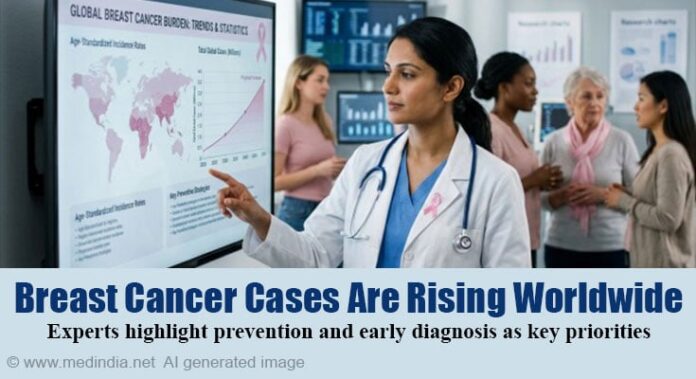
A global analysis of breast cancer data from 204 countries projects cases may exceed 3.5 million annually by 2050, highlighting lifestyle risks and care disparities.
- Global breast cancer cases projected to exceed 3.5 million annually by 2050
- Six modifiable lifestyle risks contribute to about 28% of global disease burden
- Mortality falling in high-income countries but rising in low-income regions
Breast cancer continues to be the most commonly diagnosed cancer among women worldwide, and new projections suggest the global burden could increase substantially in the coming decades (1✔ ✔Trusted Source
Global, regional, and national burden of breast cancer among females, 1990-2023, with forecasts to 2050: a systematic analysis for the Global Burden of Disease Study 2023
Go to source
).
A large modelling analysis published in the Lancet Oncology estimates that annual breast cancer cases may rise from about 2.3 million in 2023 to more than 3.5 million by 2050, while global deaths may increase from 764,000 to nearly 1.4 million during the same period.
The findings highlight widening disparities in screening and treatment access across countries and emphasize the role of preventable lifestyle factors contributing to the disease burden.
The analysis forms part of the Global Burden of Disease (GBD) Study, a long-term epidemiological assessment examining disease trends worldwide. Researchers analyzed data from population-based cancer registries, national mortality databases, and health surveillance systems across 204 countries and territories to estimate global breast cancer incidence, mortality, and health impact.
How was the Global Breast Cancer Burden Estimated?
The research represents a large observational modelling analysis examining breast cancer trends between 1990 and 2023, with projections extending to 2050.
To measure the total health impact of the disease, investigators used the metric DALYs (Disability Adjusted Life Years). This measure combines years of life lost due to premature death and years lived with disease related disability.
The study reported several key global estimates:
- Around 2.3 million new breast cancer cases occurred worldwide in 2023
- Approximately 764,000 deaths were attributed to breast cancer in the same year
- Nearly 24 million DALYs were lost globally due to breast cancer
Based on modelling projections, researchers estimate that by 2050 annual breast cancer cases could reach about 3.56 million, representing an increase of roughly 33 percent. Global breast cancer deaths are projected to rise by around 44 percent.
Population aging, increasing life expectancy, and changing lifestyle patterns are considered important factors influencing these projections.
Why do Breast Cancer Incidence and Mortality Vary Across Countries?
The study identified substantial geographic differences in breast cancer incidence and survival outcomes.
Researchers evaluated incidence using ASIR (Age Standardized Incidence Rate), which adjusts for differences in population age structure and allows comparison between countries.
Incidence rates were highest in high income countries where screening programs and diagnostic infrastructure enable earlier detection of cancer. Several countries reported incidence rates exceeding 100 new cases per 100,000 women.
In contrast, many low- and middle-income countries reported incidence rates below 13 cases per 100,000 women.
However, although incidence is currently lower in these regions, the rate of increase has been fastest in low-income countries where breast cancer incidence has risen by about 147 percent since 1990.
Mortality trends show a contrasting pattern. Age standardized mortality rates have declined by about 30 percent in high income countries, largely due to earlier detection and improved treatment. Meanwhile mortality rates have nearly doubled in low-income countries, reaching around 24 deaths per 100,000 women.
These disparities highlight the importance of early diagnosis, screening programs, and access to oncology treatment in improving survival outcomes.
Which Lifestyle Risk Factors Contribute to Breast Cancer Burden?
Researchers also examined the contribution of modifiable lifestyle and metabolic factors to global breast cancer burden.
The analysis estimated that about 28 percent of global breast cancer DALYs were linked to six modifiable risk factors:
- High red meat consumption, contributing about 11 percent of disease burden
- Tobacco exposure, including second hand smoke, contributing 8 percent
- High fasting blood glucose, contributing 6 percent
- High body mass index (BMI), contributing 4 percent
- Alcohol consumption, contributing 2 percent
- Low physical activity, contributing 2 percent
Encouragingly, the disease burden associated with tobacco exposure and alcohol consumption has declined globally between 1990 and 2023, suggesting that population level prevention strategies may influence cancer risk trends.
Is Breast Cancer Incidence Increasing Among Younger Women?
Although breast cancer remains more common among older women, the analysis identified changes in age related patterns of incidence.
In 2023 women aged 55 years and older experienced about 161 new cases per 100,000 women, compared with around 50 cases per 100,000 women among those aged 20 to 54 years.
However, since 1990 incidence among women aged 20 to 54 years has increased by approximately 29 percent globally, while rates among older women have remained relatively stable.
Researchers suggest that changes in reproductive patterns, metabolic health, and lifestyle behaviors may partly explain these trends.
Takeaway
This global analysis indicates that breast cancer will remain an important public health concern in the coming decades. Rising case numbers may increase demand for screening, diagnosis, and treatment services worldwide.
While demographic changes contribute to increasing incidence, the findings suggest that modifiable lifestyle factors account for a significant share of the global breast cancer burden.
Strengthening prevention strategies, expanding early detection programs, and improving access to cancer treatment may help reduce the future impact of breast cancer and improve outcomes for women globally.
Frequently Asked Questions
Q: What causes the projected rise in breast cancer cases worldwide?
A: Population growth, ageing populations, and lifestyle changes such as obesity, diet patterns, and reduced physical activity contribute to the increasing global burden of breast cancer.
Q: What lifestyle factors increase breast cancer risk?
A: Research indicates that smoking, high red meat intake, obesity, alcohol use, high blood sugar levels, and low physical activity are associated with increased breast cancer burden.
Q: Why are breast cancer deaths higher in low-income countries?
A: Higher mortality often reflects delayed diagnosis, limited screening programs, and restricted access to cancer treatment services such as surgery, chemotherapy, and radiotherapy.
Q: Is breast cancer becoming more common in younger women?
A: Yes. Global data show that incidence among women aged 20 to 54 years has increased by about 29 percent since 1990, although overall risk remains higher in older women.
Q: Which specialist should women consult for breast cancer screening?
A: Women should consult a medical oncologist, breast surgeon, or gynecologist for screening advice, mammography recommendations, and breast health evaluation.
Reference:
- Global, regional, and national burden of breast cancer among females, 1990-2023, with forecasts to 2050: a systematic analysis for the Global Burden of Disease Study 2023 – (https://www.thelancet.com/journals/lanonc/article/PIIS1470-2045(25)00730-2/abstract)
Source-Medindia