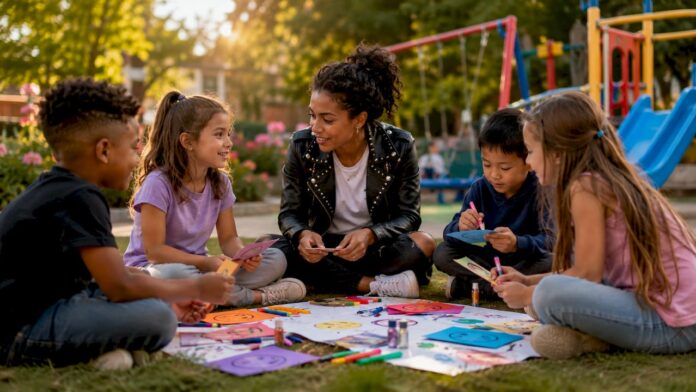
Educational mental health activities are interactive methods designed to build emotional awareness, coping skills, and mental wellness among students and communities. The field uses a more formal term: social-emotional learning (SEL), which is the recognized framework behind most school-based programs. Whether you are an educator, a mental health professional, or a parent, the right mix of structured curricula, creative arts, and digital tools makes a real difference in how young people understand and manage their emotions. Programs like NAMI’s FLARE, UNC’s Tealeaf, and the CDC’s Facts & Feels card game prove that effective mental health education does not require a clinical setting.
1. What are the most effective structured mental health education programs?
Structured mental health education programs give educators a ready-made framework so they do not have to start from scratch. Two of the strongest options available right now are NAMI’s FLARE and UNC’s Tealeaf program.
NAMI’s FLARE curriculum offers 23 modular lessons built specifically for middle schoolers. Each lesson addresses stigma, help-seeking, and mental wellness in a way that fits diverse educational standards. The modular design means a school counselor can run the full program across a semester or pick individual lessons to fill a single class period. That flexibility is rare in mental health education, and it matters enormously for busy schools.
UNC’s Tealeaf program takes a different approach. It trains teachers to use Education as Mental Health Therapy (Ed-MH) techniques grounded in behavior theory. Instead of requiring a diagnosis, Tealeaf teaches staff to identify what a student needs: attention, escape from a task, sensory input, or access to something tangible. That shift from labeling to understanding is what makes the program work across culturally diverse schools. Tealeaf has trained 50+ school staff across six schools, improving working conditions for educators alongside student outcomes.
Key features that make both programs worth implementing:
- FLARE covers stigma reduction, emotional literacy, and help-seeking in age-appropriate language
- Tealeaf equips teachers with transdiagnostic strategies they can use in real time without clinical training
- Both programs reduce teacher burnout by giving staff concrete tools instead of vague guidance
- Each can be integrated into existing school schedules without requiring a dedicated mental health class
Pro Tip: If your school is new to structured programs, start with two or three FLARE modules on stigma before introducing the full curriculum. Teachers and students both need time to build comfort with the topic.
You can find a broader breakdown of implementation strategies in this practical guide to teaching mental health in schools.
2. Which creative arts activities build resilience and emotional vocabulary?
Arts-based activities are among the most accessible school mental health activities available. They lower the barrier to participation because students express emotions through making something rather than talking about feelings directly. That distinction matters for kids who shut down in traditional discussion formats.
One of the most effective exercises is the Kintsugi-inspired “Rip and Repair” heart craft. Students tear a paper heart, then repair it with gold or yellow tape, mirroring the Japanese art of mending broken pottery with gold. The physical act of repairing something broken becomes a concrete metaphor for resilience. Creative arts activities like this one work in both clinical counseling and standard classroom settings, making them genuinely versatile.
“Arts-based activities lower barriers to participation and build emotional vocabulary effectively in school and counseling settings.” — Rock Your Homeschool
Name crafts are another strong option. Students write their name vertically and assign a personal strength or coping strategy to each letter. The activity is low-pressure, personal, and produces something the student can keep. It also gives counselors a natural opening for one-on-one conversation without forcing disclosure.
- Rip and Repair craft: Builds resilience through a physical metaphor; works for ages 8 and up
- Name strength craft: Reinforces positive self-concept; takes under 15 minutes
- Emotion collages: Students cut images from magazines to represent current feelings; no art skill required
- Feelings journals with drawing prompts: Combines visual and written expression for students who struggle with pure writing
The art and stigma reduction connection is real. When students see their own experiences reflected in creative work, the shame around mental health starts to lift.
Pro Tip: Never require students to share their art with the group. Keeping participation voluntary protects trust and keeps the activity genuinely safe for everyone.
Gamified digital tools solve one of the biggest problems in mental health education: drop-off. Clinical-style apps that present mental health as a checklist lose users fast. Gamified tools with engaging narratives improve adherence because they reward presence rather than clinical progress metrics.
The Mood app is a strong example. It uses pixel art and a digital garden that grows as users complete emotional journaling entries. The garden reflects the user’s emotional engagement over time. That visual feedback loop keeps people coming back in a way that a plain mood tracker never does. The design principle behind Mood is straightforward: embed mindfulness and reflection inside a narrative the user actually wants to return to.
| Tool Type | Engagement Mechanism | Best For |
|---|---|---|
| Mood app | Pixel art garden grows with journaling | Teens and young adults |
| CDC Facts & Feels card game | Small group discussion prompts | Groups of up to 4 students |
| Mindfulness game apps | Breathing exercises inside gameplay | Elementary and middle school |
| Digital emotion wheels | Interactive self-check-ins | Classroom warm-ups |
The CDC’s Facts & Feels card game deserves special mention. It is free, designed for groups of up to four people, and built to destigmatize mental health and substance use through structured conversation. It works as a classroom activity, a counseling group exercise, or a family discussion tool at home.
- Download or request the CDC’s Facts & Feels card game at no cost
- Use the Mood app for individual journaling outside of class time
- Pair digital tools with in-person debrief conversations to reinforce learning
- Rotate tools every few weeks to maintain novelty and sustained interest
For more ideas on embedding mental health practices into engaging formats, explore these mental health community engagement ideas that connect digital and in-person approaches.
4. What quick, evidence-based exercises reduce stress anytime?
The most practical interactive mental health exercises require no equipment and fit inside a two-minute window. The 4-7-8 breathing technique is the clearest example. You inhale for four counts, hold for seven, and exhale for eight. Combined with cognitive reframing, this method reduces stress in under 60 seconds and fits within a standard classroom transition.
Cognitive reframing pairs naturally with breathing because it targets the thought pattern driving the stress response. After the breathing cycle, students identify one negative thought and replace it with a realistic alternative. The sequence takes less than two minutes total and requires nothing beyond a quiet moment.
These quick exercises work because they are repeatable and private. A student can use them during a test, in the hallway between classes, or at home before bed. That portability makes them genuinely useful rather than something that only works in a counselor’s office.
- 4-7-8 breathing: Inhale 4 counts, hold 7, exhale 8; repeat three times
- Cognitive reframing: Name the stressful thought, then state one realistic counter-thought
- Box breathing: Inhale, hold, exhale, hold, each for four counts; widely used by athletes and military personnel
- Grounding (5-4-3-2-1): Name five things you see, four you hear, three you can touch, two you smell, one you taste
Pro Tip: Post a simple breathing chart in your classroom or on your refrigerator. Visual reminders increase the likelihood that students will actually use these techniques when stress hits.
5. How do mental health first aid kits support student privacy?
Mental Health First Aid Kit projects give students a structured way to document their own mental health plan without sharing it with anyone else. Students identify personal red flags, list their coping strategies, and name their support sources. The privacy-centered design means no peer sharing is required, which protects trust and makes the activity genuinely safe for sensitive information.
This approach works because it shifts the focus from group disclosure to personal preparation. A student who has already thought through their warning signs and coping tools is far better equipped to handle a difficult moment than one who has only discussed mental health in the abstract. The kit becomes a personal reference document the student actually owns.
Mental Health First Aid Kits work well as a culminating project at the end of a mental health unit. They synthesize everything students have learned and apply it to their own lives in a concrete, private format. Teachers can assess completion without reading the personal content, which keeps the activity educationally sound and emotionally safe.
6. Which programs use positive psychology to build long-term habits?
Positive psychology frameworks like PERMA (Positive emotions, Engagement, Relationships, Meaning, Accomplishment) shift mental health programming away from crisis response and toward building sustainable habits. The BrainWaves curriculum applies this framework directly to adolescent mental health education, focusing on what helps students thrive rather than what they need to avoid.
The practical difference shows up in how lessons are framed. A PERMA-based lesson asks students to identify three things that went well today and explain why. That simple exercise builds the habit of noticing positive experiences, which research consistently links to improved mood and resilience over time. It takes five minutes and requires no materials.
Programs grounded in positive psychology also tend to have better long-term adherence than those focused purely on symptom reduction. Students engage more consistently when the content feels relevant to their daily lives rather than clinical or remedial. That sustained engagement is what produces lasting change in emotional awareness and coping skills.
7. How can parents use these activities at home?
Parents do not need a clinical background to run effective therapeutic learning activities at home. The same tools that work in classrooms translate directly to kitchen tables and living rooms. The CDC’s Facts & Feels card game works for families of up to four. The 4-7-8 breathing technique takes two minutes before homework or bedtime. Kintsugi-inspired crafts work on a weekend afternoon.
The key for parents is consistency over intensity. A five-minute breathing practice done daily builds more resilience than a two-hour mental health workshop done once. Framing these activities as normal family routines rather than interventions removes the stigma and makes kids more likely to participate willingly.
Parents can also use mental health-themed conversation starters to open dialogue without pressure. Asking “What was one hard feeling you had today?” is less threatening than “How are you feeling about your mental health?” Small language shifts create space for honest answers.
Key takeaways
The most effective educational mental health activities combine structured curricula, creative expression, and digital tools to build emotional awareness and resilience across diverse learners and settings.
| Point | Details |
|---|---|
| Structured programs work | NAMI’s FLARE and UNC’s Tealeaf give educators ready-to-use, research-backed frameworks. |
| Arts lower barriers | Creative activities like Kintsugi crafts build emotional vocabulary without requiring verbal disclosure. |
| Gamification improves adherence | Tools like the Mood app and CDC’s card game sustain engagement better than clinical-style check-ins. |
| Quick exercises are portable | The 4-7-8 breathing technique reduces stress in under 60 seconds with no equipment needed. |
| Privacy protects trust | Activities like Mental Health First Aid Kits work best when sharing remains voluntary. |
What I’ve learned from years of watching mental health education evolve
I have watched a lot of mental health programs come and go. The ones that stick share one quality: they never make a student feel like a problem to be solved. The moment a curriculum leans too hard into diagnosis language or clinical labels, kids check out. They feel categorized instead of understood.
What actually works is variety. You need a structured program like FLARE for the students who respond to clear lessons and defined outcomes. You need arts-based activities for the kids who cannot find words for what they feel. You need something digital for the ones who will never open up in a group but will journal into an app at midnight. No single format reaches everyone.
I also feel strongly about the privacy piece. Forcing students to share personal mental health information in a group setting is one of the fastest ways to destroy trust. The Mental Health First Aid Kit model gets this right. Students do the reflective work privately and keep it for themselves. That is how you build genuine self-awareness rather than performance.
The other thing I keep coming back to is cultural sensitivity. A program designed for one community does not automatically translate to another. Tealeaf’s focus on behavioral needs rather than diagnoses works across cultural contexts precisely because it does not assume a shared framework for understanding mental illness. That kind of flexibility is not optional. It is the whole point.
Mental health education is not a one-time event. It is a habit you build slowly, the same way you build any other skill. Start small, stay consistent, and trust that the work compounds over time.
— Michelle
Start the conversation with what you wear
Mental health education does not stop at the classroom door. At Schizophrenic, we believe that what you wear can open conversations that curricula alone cannot reach. Our mental health awareness tank tops are designed to spark dialogue, reduce stigma, and signal that mental health is worth talking about openly.

Every piece in our collection is created by Michelle Hammer, a schizophrenia activist who uses bold graphic art to normalize mental illness in everyday life. Whether you are an educator wearing a conversation-starting tee on the first day of a mental health unit or a parent showing up to a school event, the message travels with you. Browse our mental health buttons and apparel to find something that fits your advocacy style and keeps the conversation going beyond the lesson plan.
FAQ
What are educational mental health activities?
Educational mental health activities are structured exercises, programs, and tools designed to build emotional awareness, coping skills, and mental wellness in students and communities. They include curricula like NAMI’s FLARE, creative arts exercises, gamified apps, and breathing techniques.
How do I promote mental health in schools without clinical training?
Programs like NAMI’s FLARE and UNC’s Tealeaf are specifically designed for educators without clinical backgrounds. Tealeaf trains teachers in behavior-based strategies that support students based on their needs rather than requiring a formal diagnosis.
What mental health games work for kids?
The CDC’s Facts & Feels card game is free and designed for groups of up to four students. It uses structured prompts to destigmatize mental health and substance use in a low-pressure, discussion-based format.
How quickly can breathing exercises reduce stress?
The 4-7-8 breathing technique combined with cognitive reframing reduces stress in under 60 seconds and fits within a two-minute session. No equipment or training is required.
Are digital mental health tools effective for students?
Gamified tools like the Mood app improve sustained engagement compared to clinical-style apps because they reward emotional presence through narrative mechanics like a growing pixel art garden. Embedding mindfulness in an engaging format reduces early drop-off significantly.
Recommended
Comments