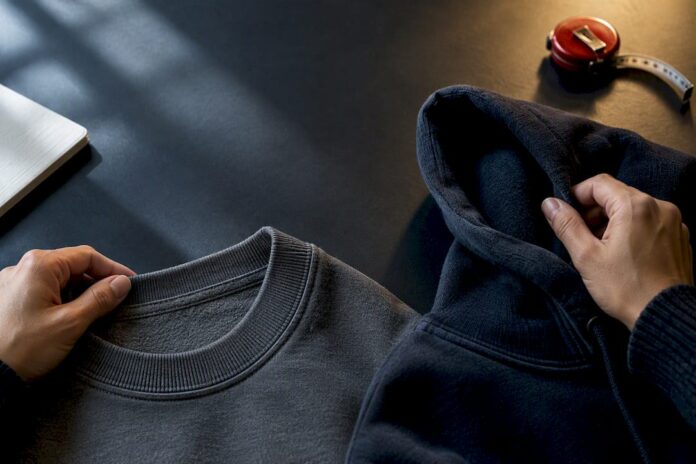
If versatility matters most, choose a midweight crewneck. If casual warmth and function top your list, choose a hoodie. But the honest answer is that fabric weight, measured in GSM, decides comfort and durability more than whether a hood is attached. Both styles are commonly sold, and either can carry your wardrobe if you match the weight to the job.
TL;DR:
- Fabrics with higher GSM, such as 400 GSM brushed fleece, provide more warmth and structure than lighter fabrics like 280 GSM French terry, regardless of style.
- Crewnecks are ideal for layering under jackets or shirts and are better suited for polished, structured outfits, while hoodies are more relaxed and functional for casual or outdoor wear.
- Hoodies have additional components like hoods, drawstrings, and kangaroo pockets that can wear out faster and require careful care, compared to crewnecks’ simpler construction.
- For versatility in a single wardrobe piece, a midweight crewneck balances warmth and layering ability, especially when stylish but less bulky garments are needed.
- Fabric weight, measured in GSM, remains the key factor in comfort and durability, overshadowing style features like hoods or pockets.
Table of Contents
Crewneck vs Hoodie: What Actually Sets Them Apart
“Sweatshirt” is the umbrella term. A crewneck is a sweatshirt with a round collar, and a hoodie is a sweatshirt with a hood — the hood is the one feature that separates the two. Everything else, from pockets to hem shape, follows from that single design choice.
The crewneck’s round collar sits flat against the neck, which means it layers cleanly under a jacket or a collared shirt without adding bulk at the throat. The hoodie adds a hood, usually with a drawstring, and often a kangaroo pocket across the front for warming your hands or stashing a phone. That pocket and hood add fabric, which adds weight and changes how the garment drapes on your body.
A few practical differences worth tracking:
- Crewnecks sit closer to the body at the neckline, making them easier to layer.
- Hoodies add bulk at the shoulders and back of the neck from the hood lining.
- Kangaroo pockets on hoodies add warmth but also add a seam that can wear out.
- Crewneck hems tend to be simpler, ribbed bands without drawcords to manage.
How Fabric Type and GSM Change Warmth and Feel
The garment name matters less than the fabric behind it. French terry is an unbrushed loopback knit that offers structure and breathability, while brushed fleece has a soft, napped interior that traps more heat but pills faster over repeated washes.
GSM, or grams per square meter, is the number that tells you how heavy and warm a fabric actually is. Everyday hoodies typically run in a moderate GSM range with midweight and heavyweight pieces offering increasing warmth and structure.
Statistic Callout: A 400 GSM crewneck in brushed fleece will run warmer than a 280 GSM hoodie in French terry, even though the hoodie has a hood. Weight beats shape when it comes to warmth.
- French terry: better structure, cleaner print definition, less warmth.
- Brushed fleece: softer hand-feel, more heat retention, faster pilling.
- Light GSM (280 to 320): fine for mild weather or indoor layering.
- Heavy GSM (400+): built for cold days and structured silhouettes.
When Should You Wear a Crewneck or a Hoodie?
Occasion decides the winner here more than comfort does. A crewneck reads cleaner and more put together, which makes it the safer pick anywhere you want to look intentional rather than thrown together.
- Crewneck under a blazer or structured coat. The flat collar disappears under a lapel, so the outfit still reads polished.
- Crewneck with chinos and boots. This is the easiest “smart casual” formula in cold weather, no hood bunching at your collar.
- Hoodie with joggers or relaxed denim. Streetwear and loungewear both lean on the hoodie’s silhouette and hand-warming pocket.
The hood itself earns its keep outdoors, walking the dog, waiting for a train, anywhere wind matters more than polish. For wearable-art pieces specifically, a crewneck often reads clearer: no hood folds interrupting a chest graphic, no drawstring cutting across a design. If you’re building an outfit around a statement piece, these styling ideas for awareness events show how the same graphic reads differently depending on the garment underneath it.
Layering, Fit, and Silhouette Under Outerwear

Fit changes how either garment performs once you add a jacket on top. A slim or regular fit crewneck slides under outerwear without adding volume at the shoulders. A hoodie’s hood, even folded down, adds a fold of fabric behind your neck that can bunch under a fitted jacket collar.
A few fit notes worth remembering:
- Choose a slim or regular fit crewneck for layering under structured coats.
- Save oversized fits for hoodies you’ll wear alone, not under a jacket.
- Check sleeve length: a hoodie’s ribbed cuffs should clear your jacket sleeve, not bunch inside it.
- A bulky kangaroo pocket can dig into your hips if you’re also wearing a backpack.
If you split time between pullover and zip-front hoodies, this breakdown of pullover versus zip styles walks through how closure type affects both fit and layering.
What Wears Out First: Care and Durability
Hoodies simply have more parts that can fail. Drawstrings fray at the eyelets, kangaroo pocket seams take stress every time you shove your hands in, and hood linings pill faster than the rest of the garment because of constant friction against your neck. A crewneck skips most of that risk by having fewer moving pieces.
- Wash both styles inside out, in cold water, to slow pilling.
- Skip high heat in the dryer; it’s the fastest way to shrink French terry.
- Check listed GSM and fabric composition on the product page before buying.
- Look for reinforced stitching at the pocket seams and drawstring eyelets on hoodies.
Pro Tip: Before buying either style online, search the product page for its GSM number. If it’s not listed, that’s usually a sign the seller doesn’t know the fabric weight either, and neither will you until it’s already in your closet.
How to Choose Between a Crewneck and a Hoodie
Three questions settle most wardrobe decisions faster than scrolling another comparison chart.
- What’s the primary use? Office layering or dressier casual wear points to a crewneck. Errands, commuting, or outdoor downtime points to a hoodie.
- Will you layer it under a jacket? If yes, the crewneck’s flat collar wins every time. Hoods add bulk you’ll feel at the shoulders.
- What silhouette do you actually wear? Slim and clean favors a crewneck. Relaxed and streetwear leaning favors a hoodie.
Match GSM to the answer: light fabric for mild weather or indoor wear, heavyweight fleece for cold-climate function. If you can only buy one piece this season, a midweight crewneck tends to be the most versatile single buy, with hoodies pulling ahead only when hand-warming pockets and hood coverage matter more to you than a clean line.
Why Certain brands choose crewnecks for certain designs
A hood folds, bunches, and interrupts a chest graphic in ways a flat crewneck collar never does. That’s why some bold designs often land on crewnecks first: the message stays legible whether you’re standing still or moving through a crowd. Material choice isn’t decoration to us. It’s whether the design does its job of starting a conversation about mental illness. A hoodie has its place too, especially when warmth and function matter more than a clean read on the art. Either way, the fabric and the message have to work together, not against each other.
— Michelle
Shop Crewnecks and Hoodies Built for Wearable-Art Messaging
Some designs are made on both crewnecks and hoodies with fabric weight and construction chosen so the artwork stays legible, not the other way around. If the checklist above pointed you toward a clean, layerable piece, look for our crewnecks in structured French terry, where prints hold their shape wash after wash. If you landed on a hoodie for warmth and function, ours are built with reinforced pocket seams and drawstrings that won’t fray after a season of daily wear. Browse the full Mental Health Hoodies And Sweatshirts collection, check the fit and fabric notes on each product page, and pick the piece that matches your wardrobe role, not just the name on the label.
Sources
FAQ
Why do Gen Z wear hoodies so often?
Hoodies function as both fashion and armor: the hood offers privacy and warmth in one move, and the silhouette fits streetwear trends that favor relaxed, oversized fits. The garment’s roots in 1920s and 1930s athletic wear gave it a functional pedigree that later crossed into skate, hip-hop, and mainstream fashion.
Do men wear crewnecks?
Yes, crewnecks are a staple in men’s wardrobes precisely because the round collar layers cleanly under jackets, blazers, and collared shirts. They read more polished than a hoodie, which makes them a common choice for smart-casual or office-adjacent settings.
Why is it called a crewneck?
The name traces back to rowing team uniforms in the early 20th century, where crew members wore simple round-collar sweaters. The “crew” in the name refers to that rowing crew, not any modern usage.
What’s the difference between a crewneck and a regular sweatshirt?
“Sweatshirt” is the umbrella category, and a crewneck is simply a sweatshirt cut with a round collar. Every crewneck is a sweatshirt, but not every sweatshirt is a crewneck, since some have hoods or different collar shapes instead.
Does Schizophrenic.NYC sell both crewnecks and hoodies?
Yes, the Mental Health Hoodies And Sweatshirts collection carries both styles, each designed around bold, legible graphics that support mental health awareness. Current prices and available sizes are listed on the product pages.
Recommended
Comments