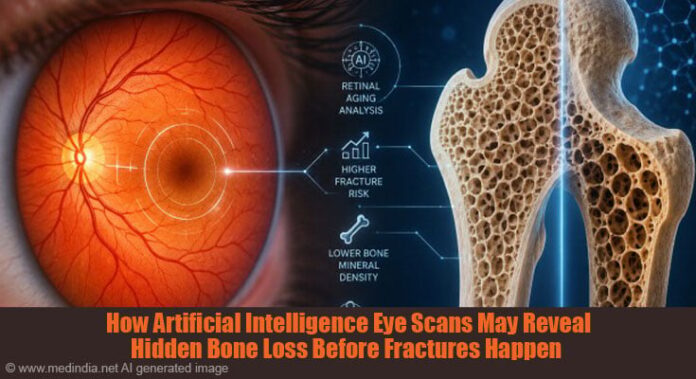
Researchers say artificial intelligence analysis of retinal images may eventually help identify hidden osteoporosis risk before fractures occur.
- Researchers found that older retinal biological age was linked to weaker bone health
- Higher retinal aging scores were associated with greater fracture and osteoporosis risk
- Scientists say retinal imaging may eventually support earlier osteoporosis screening
Osteoporosis is often discovered only after a fracture happens (1✔ ✔Trusted Source
Retinal biological age correlates with bone mineral density and fracture risk score and predicts incident osteoporosis
Go to source
).
A minor fall, a sudden hip fracture, shrinking height, or persistent back pain may become the first visible signs that bones have been weakening silently for years.
Now, scientists say the answer to earlier osteoporosis detection may partly lie inside the eye.
A major new study published in PLOS Digital Health found that artificial intelligence analysis of retinal photographs could identify biological aging patterns strongly linked to lower bone mineral density, higher fracture risk, and future osteoporosis development (1✔ ✔Trusted Source
Retinal biological age correlates with bone mineral density and fracture risk score and predicts incident osteoporosis
Go to source).
Researchers discovered that people with “older” appearing retinas were significantly more likely to show weaker bone health and later develop osteoporosis.
The findings are attracting attention because retinal imaging is simple, non-invasive, relatively low-cost, and already widely used in eye care.
Researchers say this raises the possibility that ordinary retinal scans may eventually help identify hidden osteoporosis risk long before fractures occur.
Why Does Osteoporosis Often Remain Undetected for So Long?
Osteoporosis is a skeletal disease in which bones gradually lose density, strength, and structural integrity. As bones become more fragile, fracture risk rises sharply.
Researchers explain that osteoporosis is often called a “silent disease” because bone loss may continue for years without pain or obvious symptoms. Many patients are only diagnosed after suffering:
The condition has become a growing global public health concern as populations age.
The PLOS Digital Health study noted that osteoporosis currently affects nearly one-fifth of the global population, with prevalence increasing significantly with age.
Researchers say untreated osteoporosis may lead not only to fractures but also:
- Reduced mobility
- Long-term disability
- Loss of independence
- Higher hospitalization rates
- Increased mortality in older adults
Despite these serious consequences, osteoporosis remains substantially underdiagnosed.
The gold-standard diagnostic tool is the Dual-Energy X-ray Absorptiometry scan, commonly known as a DEXA scan, which measures bone mineral density (BMD).
However, researchers say DEXA scans are expensive, less accessible in many regions, and often reserved mainly for patients already considered high-risk.
As a result, many people never undergo screening until fractures have already occurred.
Why Did Scientists Start Looking at the Retina for Bone Disease?
Researchers increasingly believe the retina may reveal much more than eye disease alone.
The retina contains an extremely dense network of blood vessels and nerve tissues that may reflect broader biological aging and vascular health happening throughout the body.
Scientists now describe the eye as a potential “window” into systemic aging. Recent advances in artificial intelligence have dramatically accelerated this field.
Researchers have already developed retinal AI systems capable of predicting:
- Cardiovascular disease
- Kidney disease
- Diabetes complications
- Parkinson’s disease
- Mortality risk
- Biological age
The osteoporosis study used an AI-based retinal biological aging tool called RetiAGE.
This deep-learning system analyzes retinal photographs and estimates whether the retina appears biologically older than expected.
Researchers say accelerated retinal aging may reflect broader biological aging occurring simultaneously in multiple organs and tissues throughout the body.
Scientists suspected that because aging affects both blood vessels and bones, retinal aging patterns might correlate with skeletal deterioration as well.
How Did Researchers Study the Link Between Retinal Aging and Osteoporosis?
The researchers analyzed two very large population datasets.
The first was the Singapore-based PIONEER study involving 1,965 older adults who underwent both retinal imaging and DEXA bone scans on the same day.
The second involved 43,938 participants from the UK Biobank who did not have osteoporosis initially but were followed over time to see who later developed the disease.
Researchers compared retinal biological age scores with:
- Bone mineral density
- T-scores from DEXA scans
- Fracture risk scores
- Future osteoporosis development
The study found that older retinal biological age was consistently associated with weaker bone health.
In the Singapore PIONEER analysis:
- Higher retinal aging scores were linked to lower bone mineral density in multiple hip regions
- Lower T-scores were observed in important skeletal areas
- Fracture risk scores were significantly higher
In the UK Biobank cohort, individuals with older retinal biological age were also significantly more likely to develop osteoporosis later over time.
Researchers say these findings suggest that retinal biological aging may reflect systemic processes affecting the skeleton. To better understand what the researchers observed across both major population studies, the table below summarizes how retinal aging patterns appeared to track with worsening bone health.
| Retinal Finding Seen on AI Analysis | What It Suggested About Bone Health |
|---|---|
| Retina appeared biologically “older” | Bone mineral density was often lower |
| Higher RetiAGE scores | Greater predicted fracture risk |
| Accelerated retinal aging | Higher future osteoporosis risk |
| Lower hip-region bone density | Stronger association with older retinal age |
| Higher fracture assessment scores | Greater skeletal fragility risk |
| Faster biological aging signals in the retina | Possible whole-body aging effects involving bones and blood vessels |
Researchers say the findings support the idea that aging processes in the retina may mirror broader biological aging throughout the body, including in bones.
Why Might Bone Disease and Retinal Aging Be Connected?
Scientists believe several shared biological pathways may help explain the connection.
The study explained that chronic inflammation, oxidative stress, calcium imbalance, vitamin D dysregulation, vascular aging, and cellular degeneration may contribute both to retinal aging and bone loss.
Researchers say aging rarely affects only one organ in isolation. Instead, multiple tissues often age together through interconnected biological mechanisms.
A separate study published in Experimental Gerontology found additional evidence linking osteoporosis with age-related macular degeneration (AMD), a major retinal disease that affects vision in older adults (2✔ ✔Trusted Source
Exploring the causal relationship between osteoporosis and age-related macular degeneration: Evidence from observational studies and mendelian randomization
Go to source).
That study reported:
- Osteoporosis increased the risk of dry AMD in women
- Genetic analyses suggested a possible causal relationship
- Shared inflammatory and oxidative pathways may contribute to both diseases
Researchers explained that:
- Chronic inflammation
- Oxidative stress
- Vitamin D abnormalities
- Calcium metabolism disruption
may simultaneously affect skeletal tissue and retinal tissue.
The authors also noted that retinal imaging may become increasingly valuable because it provides a non-invasive opportunity to study systemic biological aging without exposing patients to radiation.
Why Could These Findings Matter Greatly for India?
Researchers say the findings may carry major implications for countries like India, where osteoporosis remains highly under-recognized despite rapidly aging populations.
A review published in the Indian Journal of Orthopedics reported that osteoporosis prevalence among Indian women has ranged from 8% to 62% across different studies (3✔ ✔Trusted Source
Epidemiology of Osteoporosis
Go to source).
The review identified several major contributors to poor bone health in India:
- Low calcium intake
- Widespread vitamin D deficiency
- Poor awareness
- Reduced physical activity
- Urban indoor lifestyles
- Poor nutrition
- Increasing alcohol consumption and smoking
Researchers noted that:
- Many Indian diets remain low in calcium and vitamin D
- Vegetarian diets high in phytates may reduce calcium absorption
- Urban lifestyles reduce sun exposure needed for vitamin D production
The review estimated that vitamin D deficiency may affect nearly 80% of urban Indians.
At the same time, osteoporosis awareness remains very poor.
The authors reported that general awareness about osteoporosis prevention and bone health may be as low as 15% in some populations. Researchers warn that India’s osteoporosis burden may rise sharply in the coming decades because of increasing life expectancy and a rapidly expanding elderly population.
This is why scientists believe simpler screening approaches may become increasingly important.
Could Eye Scans Eventually Help Detect Hidden Disease Across the Body?
Researchers say the osteoporosis study is part of a much larger transformation happening in medicine.
A systematic review published in eClinicalMedicine examined how artificial intelligence analysis of retinal images is increasingly being used to detect systemic diseases associated with diabetes and vascular aging (4✔ ✔Trusted Source
Use of artificial intelligence with retinal imaging in screening for diabetes-associated complications: systematic review
Go to source).
The review found retinal AI systems capable of helping identify:
- Cardiovascular disease
- Kidney disease
- Mortality risk
- Parkinson’s disease
- Metabolic disorders
- Neurological disease
Researchers say retinal imaging offers several major advantages:
- Non-invasive
- Fast
- Relatively affordable
- Easily repeatable
- Already widely used in eye clinics
Scientists believe this emerging field — sometimes called “oculomics” — may eventually allow the eye to function as a broader biological screening tool for whole-body aging and disease risk.
Still, researchers caution that retinal AI tools are not yet replacing standard osteoporosis diagnosis methods such as DEXA scans.
The osteoporosis study authors emphasized that more long-term validation studies are still needed before retinal imaging can be routinely used for population-level osteoporosis screening.
However, many scientists believe the findings represent an important step toward a future where a simple eye scan may help identify hidden disease risks far beyond vision problems alone.
Rather than viewing the retina only as part of the eye, researchers increasingly believe it may function as a biological window into how the entire body is aging — including the bones themselves.
Frequently Asked Questions
Q: What is osteoporosis?
A: Osteoporosis is a disease in which bones gradually become weaker, more fragile, and more likely to fracture.
Q: How could eye scans help detect osteoporosis?
A: Researchers found that biological aging patterns visible in retinal photographs were linked to lower bone density and higher fracture risk.
Q: What is RetiAGE?
A: RetiAGE is an artificial intelligence-based retinal aging tool that estimates whether the retina appears biologically older than expected.
Q: Why is osteoporosis often called a silent disease?
A: Bone loss usually develops gradually without obvious symptoms, so many people are diagnosed only after suffering fractures.
Q: What is a DEXA scan?
A: A DEXA scan is the standard medical test used to measure bone mineral density and diagnose osteoporosis.
References:
- Retinal biological age correlates with bone mineral density and fracture risk score and predicts incident osteoporosis – (https://journals.plos.org/digitalhealth/article?id=10.1371/journal.pdig.0001360&utm_source=pr&utm_medium=email&utm_campaign=plos006 )
- Exploring the causal relationship between osteoporosis and age-related macular degeneration: Evidence from observational studies and mendelian randomization – (https://www.sciencedirect.com/science/article/pii/S0531556526000380)
- Epidemiology of Osteoporosis – (https://pmc.ncbi.nlm.nih.gov/articles/PMC10721571/)
- Use of artificial intelligence with retinal imaging in screening for diabetes-associated complications: systematic review – (https://www.thelancet.com/journals/eclinm/article/PIIS2589-5370(25)00021-5/fulltext)
Source-Medindia