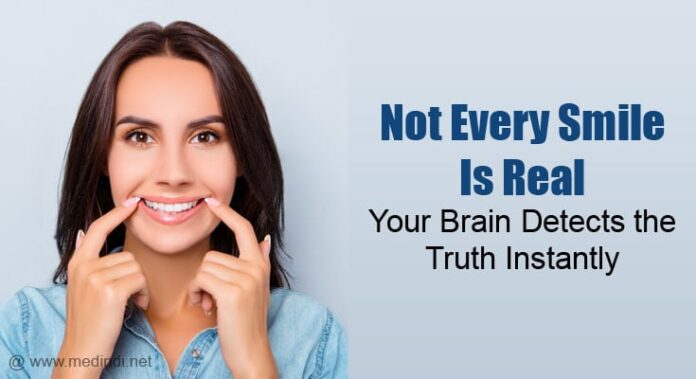
Scientific studies reveal how eye muscles, timing, and facial symmetry help the brain distinguish genuine smiles from fake expressions.
- Genuine smiles involve both mouth and eye muscles
- Fake smiles appear suddenly and fade quickly
- Brain scans show stronger emotional activation for real smiles
Smiling is one of the most common human expressions, often linked with happiness, warmth, and friendliness. However, psychological research confirms that not all smiles represent genuine emotions (1✔ ✔Trusted Source
The Duchenne smile: emotional expression and brain physiology. II
Go to source
).
Many smiles are socially motivated, used to appear polite, reduce tension, or mask discomfort. Scientists have long studied how the human brain distinguishes between real and fake smiles, revealing measurable differences in facial muscle activity, timing, and emotional processing.
A genuine smile, scientifically known as the Duchenne smile, reflects true positive emotion and activates involuntary facial muscles that cannot be easily controlled. In contrast, a fake or posed smile is typically deliberate and lacks key emotional markers.
TOP INSIGHT

Did You Know?
Your brain can detect a #FakeSmile in milliseconds because real #happiness activates eye muscles that cannot be consciously controlled. #smiles #realsmile #emotions #duchennesmile
Science Behind Genuine and Fake Smiles
Classic psychological research shows that a Duchenne smile involves simultaneous contraction of two muscles. The zygomaticus major lifts the corners of the mouth, while the orbicularis oculi tightens muscles around the eyes, creating natural crow’s feet. Studies using facial electromyography confirm that eye muscle activation occurs automatically during genuine happiness and is extremely difficult to fake voluntarily.
Timing Patterns That Reveal Emotional Authenticity
Timing plays a critical role in smile authenticity. Experimental studies analyzing video frames show that genuine smiles emerge gradually and fade slowly. Fake smiles tend to appear suddenly in response to social cues and disappear quickly once the interaction ends.
Controlled experiments reported that spontaneous smiles last significantly longer than deliberate ones and display smoother onset and offset patterns. These timing differences provide reliable cues for emotional authenticity even without conscious awareness.
Brain Activity Differences Between Real and Fake Smiles
Neuroimaging studies show that genuine smiles activate emotion related brain regions involved in reward processing and social bonding. Fake smiles produce weaker activation in these areas and greater engagement of brain regions responsible for cognitive control.
This neurological mismatch explains why fake smiles often feel uncomfortable or insincere despite appearing socially acceptable.
Why Humans Detect Fake Smiles Instinctively
Evolutionary psychology suggests that detecting genuine emotion improved survival by helping humans assess trust and cooperation. Research confirms that people identify real smiles more accurately than fake ones, often within fractions of a second.
Individuals with higher emotional intelligence show stronger sensitivity to eye cues and facial timing, improving interpersonal communication and empathy.
Final Takeaway
A smile is more than a mouth movement. Genuine smiles involve involuntary eye muscle activation, natural timing, and stronger emotional brain responses. While fake smiles serve social functions, the human brain is remarkably skilled at sensing emotional truth, reinforcing the importance of authentic expression for mental well-being and healthy relationships.
Frequently Asked Questions
Q: How can you tell if a smile is fake or real?
A: A real smile activates eye muscles and fades naturally, while a fake smile mainly involves the lips and disappears quickly.
Q: What is a Duchenne smile?
A: It is a genuine smile involving both mouth and eye muscles, reflecting true happiness.
Q: Can people consciously fake a genuine smile?
A: Eye muscle activation is involuntary, making genuine smiles extremely difficult to fake convincingly.
Q: Why do fake smiles feel uncomfortable?
A: The brain detects mismatched emotional and facial signals, creating a sense of inauthenticity.
Q: Are fake smiles harmful to mental health?
A: Occasional social smiling is normal, but constant emotional masking may increase stress and emotional fatigue.
Reference:
- The Duchenne smile: emotional expression and brain physiology. II – (https://pubmed.ncbi.nlm.nih.gov/2319446/)
Source-Medindia