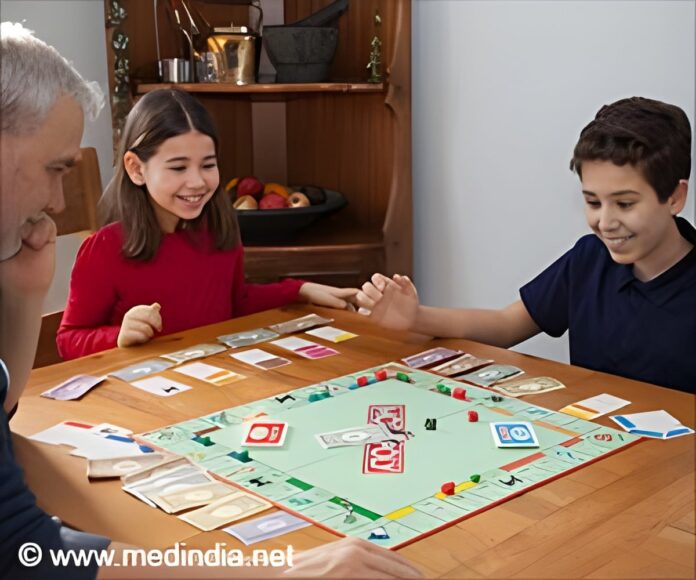
A few 10-minute number board games can leave lasting gains in young children’s early math learning.
Research shows that linear number board games, where children move pieces along a straight numbered track, can significantly boost early math abilities. The HEDCO Institute for Evidence-Based Educational Practice at the UO reports that even brief 10-minute game sessions can produce lasting improvements in math-related skills.(1✔ ✔Trusted Source
Investigating Main Effects and Moderators of Linear Number Board Games: A Meta-Analytic Review
Go to source
)
TOP INSIGHT

Did You Know?
Playing #boardgames is linked to enhanced fluid #intelligence, logical thinking and verbal #workingmemory, all core components of what #IQtests measure.
#cognitiveboost #braingames #iqinsights #boardgamebenefits #medindia
Number Board Games and Math Development
The findings are from a meta-analysis, or systematic review, of 18 studies looking at number board games and early math skills in children preschool through second grade.
“We selected this topic because early math skills are a powerful predictor of children’s later success in school, and number board games are easy to use and affordable,” said Gena Nelson, associate research professor at the Center on Teaching and Learning at the UO’s College of Education.
“This review shows that brief play sessions with linear-number board games can meaningfully improve foundational early math skills like counting, number recognition and understanding quantity,” she said.
How Number Board Games Influence Early Numeracy
The review found a 76 percent chance that playing these games will improve numeracy — the ability to understand and use numbers — if the children and games are like those in the studies. Numeracy includes skills like counting in order, counting each item in a set only once, and understanding that the last number counted refers to the total number of objects in the set.
The findings are relevant for educators and homeschoolers looking for activities proven to help students, as well as family members and mentors who want to have fun with the children in their lives while also supporting their learning.
Highlights from the Evidence-Based Report
The easy-to-read report, “Evidence-Based Ways to Play: Linear Number Board Games Support Numeracy Skills for Young Children,” focuses on games that are backed by credible research, sifting them out of hundreds of game ideas available online.
Examples include The Great Race from the Early Childhood Interaction Lab at the University of Maryland and resources from the DREME Family Math and the Center for Family Math.
The report includes links to The Great Race and other downloadable games and resources.
Applying the Insights to Inclusive Learning Tools
HEDCO Institute researchers Nelson and Marah Sutherland undertook this systematic research review hoping to incorporate features from some of the best number board games into those they’re designing for their own research study of board play for children with disabilities.
“We are testing a set of original number games, storybooks with math themes, and math conversational prompts to be used in the home with parents who have a 3- to 5-year-old child with a disability,” said Sutherland, research associate at the UO’s Center on Teaching and Learning. “Something that we learned from our meta-analysis was the need for early math activities to be highly adaptable based on children’s readiness for learning about different numbers.”
She said they integrated that into the design of their own number board games by providing different levels and optional math challenges for parents to incorporate, depending on the math skills of their child.
“The response from parents about using the adaptable math activities at home with their children with diverse learning needs has been overwhelmingly positive,” she said.
Reference:
- Investigating Main Effects and Moderators of Linear Number Board Games: A Meta-Analytic Review – (https://journals.sagepub.com/doi/10.3102/00346543251383552)
Source-University of Oregon