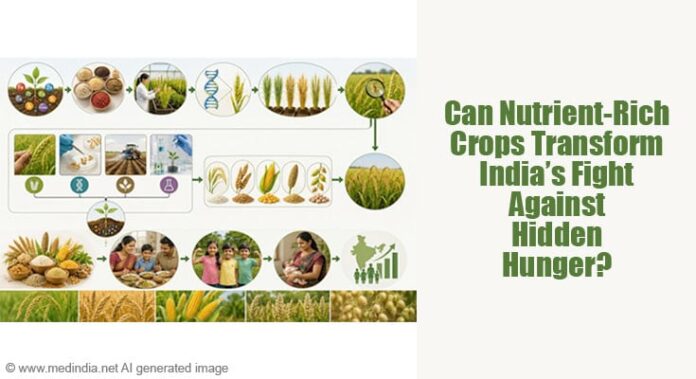
ICAR has developed 203 biofortified crop varieties as India pushes to tackle anemia and malnutrition through nutrient-rich everyday staples.
- ICAR has developed 203 biofortified crop varieties enriched with iron, zinc, protein, and vitamins
- More than 67% of Indian children and over half of women continue to suffer from anemia
- Scientists say nutrient-rich staple foods could help improve long-term nutrition and health
India’s fight against malnutrition may increasingly begin not in hospitals or supplement programs, but in its farms and everyday food staples.
With nearly 67% of Indian children and more than half of women affected by anemia, scientists are now transforming ordinary crops like rice, wheat, maize, and millets into nutrient-rich foods designed to tackle the country’s growing “hidden hunger” crisis (1✔ ✔Trusted Source
Biofortified Varieties:Sustainable Way to Alleviate Malnutrition
Go to source
).
The Indian Council of Agricultural Research (ICAR) has developed 203 biofortified crop varieties enriched with nutrients such as iron, zinc, protein, calcium, and vitamins between 2014 and 2025.
These include iron-rich rice, protein-rich wheat, zinc-fortified maize, and nutrient-dense millets aimed at improving nutrition without forcing families to drastically change what they eat every day.
The initiative comes at a time when India continues to face a major burden of anemia and micronutrient deficiency despite record foodgrain production. According to figures cited in the ICAR report, 67.1% of Indian children aged 6–59 months are anemic, while more than 57% of women aged 15–49 years also suffer from anemia.
Researchers say this reflects a deeper nutritional problem known as “hidden hunger” — a condition where people may consume enough calories but still lack essential nutrients such as iron, zinc, vitamin A, and protein.
Unlike conventional food fortification, where nutrients are added during processing, biofortification naturally increases nutrient levels inside crops through breeding and genetic improvement, allowing nutrients to reach people through foods they already consume daily.
Why Is anemia Still Affecting Millions Across India?
Anemia has remained one of India’s largest public health challenges for decades, particularly among children, adolescent girls, and women of reproductive age. Experts say the condition not only weakens physical health but also affects brain development, learning ability, immunity, and future productivity.
According to UNICEF, India operates the world’s largest universal adolescent anemia control program, targeting nearly 116 million adolescent girls and boys. Yet anemia continues to affect a huge section of the population, especially in poorer communities where diets are heavily dependent on cereal-based staples with limited nutrient diversity (2✔ ✔Trusted Source
Forging an Anemia-Free Future
Go to source).
UNICEF notes that anemic adolescent girls face increased risks during pregnancy, including maternal death, premature delivery, and low-birth-weight babies. Their children are also more likely to become anemic, creating an intergenerational cycle of poor nutrition and health.
While iron deficiency remains one of the major causes of anemia in India, newer research suggests the problem may be far more complex than previously understood.
A review published in Nutrients reported that anemia in India has a multifactorial etiology and may not be solely due to iron deficiency.
Researchers highlighted the possible roles of vitamin B12 and folate deficiencies, poor sanitation, infections, worm infestation, socioeconomic inequality, and maternal health problems in worsening anemia rates (3✔ ✔Trusted Source
Anaemia in India and Its Prevalence and Multifactorial Aetiology: A Narrative Review
Go to source).
The review also noted that anemia prevalence in India increased between NFHS-4 and NFHS-5 surveys:
- Childhood anemia rose from 58.6% to 67.1%
- Anemia among non-pregnant women increased from 53.2% to 57.2%
Researchers warned that improving access to nutrient-rich foods may become just as important as supplementation programs in controlling the country’s anemia burden.
What Makes Biofortified Crops Different From Regular Crops?
Biofortification focuses on improving the nutritional quality of crops directly through breeding methods so that the nutrients are naturally present inside the grain, fruit, or vegetable itself.
According to the ICAR report, scientists are enhancing nutrients such as iron, zinc, calcium, protein, vitamin A, vitamin C, lysine, and tryptophan in edible crop parts through conventional and molecular breeding techniques.
Researchers say this approach offers a major advantage because people receive nutrients from the foods they already eat every day, rather than depending entirely on supplements or industrially fortified packaged products.
ICAR argues that biofortification may also be more sustainable than repeated supplementation programs because nutrients are delivered through natural food systems.
The report describes biofortified crops as cost-effective, easier to distribute, and capable of improving nutrition without increasing food prices.
The program has expanded rapidly over the last decade. Earlier editions of the initiative had reported 87 biofortified cultivars across 16 crops, but the latest figures now show 203 nutrient-rich varieties developed between 2014 and 2025. These include dozens of biofortified wheat, maize, rice, millet, pulse, vegetable, and fruit varieties.
Researchers say the goal is not only to improve nutrition, but also to maintain strong agricultural productivity so farmers do not lose yield while growing healthier crops.
How Are Scientists Turning Everyday Staples Into Nutrient-Rich Foods?
The ICAR publication details how common Indian staples are being redesigned nutritionally to address widespread micronutrient deficiencies.
Some rice varieties now contain much higher levels of zinc and protein than conventional rice, while wheat varieties have been enriched with iron, zinc, and protein.
Certain maize hybrids have also been developed with higher lysine, tryptophan, and provitamin-A levels — nutrients important for immunity, growth, and brain development.
The report explains that deficiencies of these nutrients can have serious long-term health consequences.
Iron deficiency may cause anemia, fatigue, and delayed growth, while zinc deficiency weakens immunity and increases vulnerability to infections. Vitamin A deficiency affects vision and immune function, and protein deficiency can impair both physical and cognitive development.
| Biofortified Crop Strategy | Why It Matters for Public Health |
|---|---|
| Iron-rich rice and wheat | Helps reduce anemia and iron deficiency |
| Zinc-enriched grains | Supports immunity and child growth |
| Protein-rich wheat and maize | Improves physical and cognitive development |
| Vitamin-A enriched crops | Supports vision and immune health |
| Nutrients built directly into staple foods | Makes healthier diets easier without changing eating habits |
| High-yield nutrient-rich crops | Helps farmers improve nutrition without losing productivity |
Researchers say this shift is important because India’s challenge is no longer only food security, but nutrition security — ensuring people receive both enough food and enough nutrients.
Are Biofortified Crops Actually Showing Health Benefits?
Scientists say early evidence supporting biofortified crops is encouraging.
A randomized trial published in Clinical Nutrition studied iron- and zinc-biofortified pearl millet among children aged 12–18 months living in Mumbai slums. At the beginning of the trial:
- Nearly half the children were already anemic
- Around 60% had iron deficiency (4✔ ✔Trusted Source
A randomized trial of iron- and zinc-biofortified pearl millet-based complementary feeding in children aged 12–18 months living in urban slumsGo to source
)
Researchers found that children consuming biofortified pearl millet showed improved hemoglobin levels and lower anemia prevalence compared to children consuming conventional millet. By the end of the study, anemia prevalence was significantly lower among children consuming biofortified pearl millet.
Another review published in the Journal of Food Composition and Analysis noted that nearly 2 billion people globally suffer from zinc and iron deficiencies and described biofortified wheat as a promising strategy to combat hidden hunger and improve food security (5✔ ✔Trusted Source
Biofortification strategies for wheat: Enhancing zinc and iron nutritional quality to combat micronutrient deficiencies and ensure food security
Go to source).
Researchers explained that biofortification combines:
- Conventional breeding
- Agronomic practices
- Biotechnology
To improve nutrient levels while maintaining crop productivity and consumer acceptance. The review also highlighted successful Indian biofortified wheat varieties with higher iron and zinc concentrations.
Why Is India Now Linking Agriculture Directly With Public Health?
Researchers increasingly believe that many of India’s future health challenges may need to be addressed through food systems as much as through healthcare systems.
ICAR’s report repeatedly stresses that India must move from “food security” toward “nutrition security,” where food is judged not only by quantity but also by its ability to improve long-term health.
The report highlights that malnutrition affects:
- Physical growth
- Immunity
- Learning ability
- Productivity
- Economic development
India also continues to face high levels of stunting, wasting, underweight prevalence, and micronutrient deficiency despite producing record foodgrain quantities.
The economic consequences are equally serious. According to the report, India loses more than US$12 billion in GDP annually because of vitamin and mineral deficiencies, while global malnutrition in all forms is estimated to cost society up to US$3.5 trillion every year.
As evidence linking nutrition with long-term disease risk continues to grow, India is now trying to bring agriculture and public health closer together through national policy. This broader shift has led to the launch of the SEHAT mission — Science Excellence for Health through Agricultural Transformation — a joint initiative by ICMR and ICAR aimed at connecting farming, nutrition, and healthcare more directly (6✔ ✔Trusted Source
ICMR-ICAR Launches ‘SEHAT’ to Strengthen Agriculture-Nutrition-Health Convergence and Deliver Measurable Public Health Outcomes
Go to source).
The program focuses on:
- Biofortified crops
- Nutrition-sensitive farming systems
- Disease prevention
- Healthier food production
Researchers say the idea is to move beyond simply producing large quantities of grains and instead ensure that food systems actively improve public health outcomes.
Union health minister J.P. Nadda described SEHAT as a major step toward preventive healthcare, while agriculture minister Shivraj Singh Chouhan emphasized that food itself can become medicine when agricultural production is aligned with the nutritional needs of the population.
Experts believe this reflects a larger change in thinking. Instead of focusing only on treating conditions like malnutrition, diabetes, hypertension, and other chronic diseases after they develop, scientists increasingly believe healthier crops and better nutrition systems could help prevent many of these problems much earlier.
India’s scientists now hope these nutrient-rich staples can help shift the country from calorie security toward true nutrition security — where food is valued not only for filling stomachs, but also for improving long-term health and well-being.
Frequently Asked Questions
Q: What are biofortified crops?
A: Biofortified crops are food crops naturally enriched with nutrients like iron, zinc, protein, and vitamins through plant breeding methods.
Q: Why is India promoting biofortified crops?
A: India is promoting biofortified crops to fight anemia, hidden hunger, and micronutrient deficiencies through everyday staple foods.
Q: How are biofortified crops different from fortified foods?
A: Fortified foods have nutrients added during processing, while biofortified crops naturally contain higher nutrients inside the crop itself.
Q: Which nutrients are commonly added through biofortification?
A: Scientists mainly enhance iron, zinc, protein, calcium, vitamin A, and other essential nutrients in staple crops.
Q: Can biofortified crops help reduce anemia?
A: Researchers say biofortified crops may help improve iron intake and reduce anemia risk, especially in vulnerable populations.
References:
- Biofortified Varieties:Sustainable Way to Alleviate Malnutrition – (https://icar.org.in/sites/default/files/2022-06/Biofortified-Varieties-4th-Edition.pdf)
- Forging an Anemia-Free Future – (https://www.unicef.org/india/stories/forging-anemia-free-future)
- Anaemia in India and Its Prevalence and Multifactorial Aetiology: A Narrative Review – (https://pmc.ncbi.nlm.nih.gov/articles/PMC11174870/)
- A randomized trial of iron- and zinc-biofortified pearl millet-based complementary feeding in children aged 12–18 months living in urban slums – (https://www.sciencedirect.com/science/article/pii/S0261561425002961)
- Biofortification strategies for wheat: Enhancing zinc and iron nutritional quality to combat micronutrient deficiencies and ensure food security – (https://www.sciencedirect.com/science/article/abs/pii/S0889157525008245)
- ICMR-ICAR Launches ‘SEHAT’ to Strengthen Agriculture-Nutrition-Health Convergence and Deliver Measurable Public Health Outcomes – (https://www.pib.gov.in/PressReleasePage.aspx?PRID=2259959®=3&lang=2)
Source-Medindia