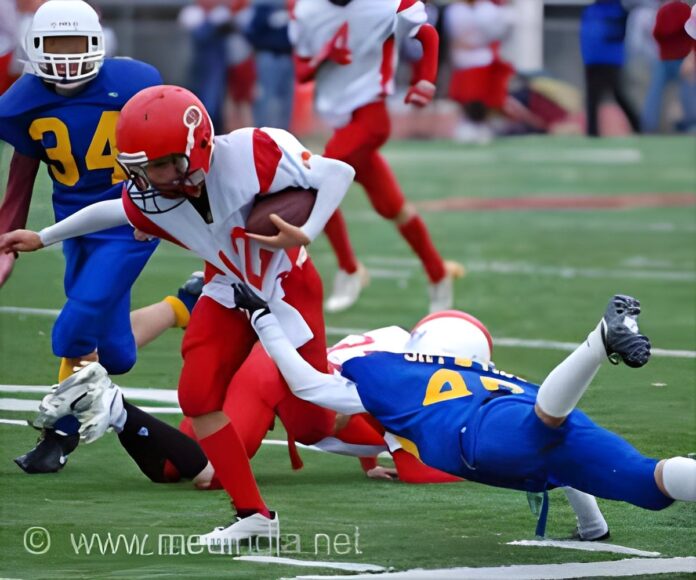
Could a simple light-based therapy help protect football players from brain injury and CTE? Experts call the early findings incredibly groundbreaking.
Football has long been woven into the fabric of American college life, but mounting evidence about its toll on brain health has pushed the sport into an uncomfortable reckoning. While concussions dominate headlines, researchers say the far greater danger may lie in the hundreds of routine head impacts players absorb each season—many without ever being diagnosed or sidelined.
Now, a small but striking new study suggests a potential way to protect athletes’ brains before damage accumulates: a light-based headset that looks more like gaming gear than medical equipment. ()
TOP INSIGHT

New research offers hope in the fight against #CTE.
College #football_players using a light-based headset (#red_light_therapy) showed stable #brain_scans, while those on placebos saw markers of #inflammation and #stress. A potential game-changer for #athletesafety!
#BrainHealth #NCAA #MedicalResearch
University of Utah Researchers Test Light Therapy to Protect Football Brains
Researchers at the University of Utah School of Medicine, led by Dr. Hannah M. Lindsey and Dr. Elisabeth A. Wilde, tested a technology known as transcranial photobiomodulation, a therapy that delivers near-infrared light through the skull.
The findings, published in the Journal of Neurotrauma, mark the first controlled study to examine whether this approach can protect the brains of active football players exposed to repetitive head impacts.
The study followed 26 Division I college football players across a 16-week season. Half used an active light-emitting headset and nasal device for 20 minutes, three times a week, while the other half used identical placebo devices that emitted no light.
At the end of the season, MRI scans revealed a stark contrast.
Players in the placebo group showed significant increases in brain inflammation and stress markers—changes researchers associate with repeated head impacts. In contrast, those using the active light therapy showed little to no change, with brain scans resembling preseason baselines.
“My first reaction was, ‘There’s no way this can be real,’” Dr. Lindsey said. “That’s how striking it was.”
Experts say the findings address a largely invisible problem in football. For every diagnosed concussion, studies estimate players sustain 125 to 440 sub-concussive head impacts that never trigger medical protocols. Some athletes experience dozens of such hits in a single season.
Research has increasingly linked these repetitive impacts—concussion or not—to cognitive decline, altered brain activity, and chronic inflammation, raising concerns about long-term risks such as depression, memory loss, and chronic traumatic encephalopathy (CTE).
CTE: A Degenerative Brain Disease With No Cure
CTE, a degenerative brain disease found in many former football players, has no cure and can lead to severe cognitive, emotional, and motor impairments. More than 100 former NFL players have been diagnosed posthumously, with many more cases suspected.
Until now, efforts to address football’s brain injury crisis have largely been reactive—better helmets, stricter concussion protocols, and rule changes. While important, researchers say these measures do little to address the cumulative damage caused by routine impacts.
Photobiomodulation: A Light-Based Approach to Reducing Brain Inflammation
Photobiomodulation offers a different approach.
Previous studies have shown that red and near-infrared light can reduce inflammation by boosting cellular energy production and improving blood flow. Applied to the brain, researchers believe the therapy may help limit the inflammatory cascade triggered by repeated impacts.
“The mechanism makes sense,” said Dr. Kristen Dams-O’Connor, director of Mount Sinai’s Brain Injury Research Center, who was not involved in the study. “If this can mitigate acute inflammation, it may be a meaningful step toward safer sports.”
Outside experts have described the findings as promising—but preliminary.
Dr. Shae Datta, co-director of the NYU Langone Concussion Center, called the results “incredibly groundbreaking,” while stressing that the study does not prove the therapy can prevent CTE or long-term cognitive decline.
“We don’t have enough information to say this prevents CTE,” Datta said. “But reducing neuroinflammation is a logical target, because that’s what drives long-term damage.”
Researchers also caution that commercially available red-light devices are not equivalent to the specialized equipment used in the study, which relies on specific wavelengths capable of penetrating the skull.
Expanded Trials Planned to Test Light Therapy for Brain Injuries
Encouraged by consistent findings across multiple studies, the University of Utah team is expanding its research. A Department of Defense–funded trial involving 300 participants—including veterans, first responders, and service members with persistent concussion or traumatic brain injury symptoms—is set to begin recruitment in early 2026.
“This is non-invasive, doesn’t involve medication, and appears well tolerated,” Dr. Wilde said. “If future studies confirm safety and effectiveness, the implications could extend far beyond football.”
For now, the headset is not a cure, nor a guarantee of safety. But in a sport searching for ways to protect players without sacrificing competition, it represents something football has rarely had in recent years: a reason for cautious hope.
References:
- Transcranial Photobiomodulation Promotes Neurological Resilience in Current Collegiate American Football Players Exposed to Repetitive Head Acceleration Events – (https://journals.sagepub.com/doi/10.1177/08977151251403554)
Source-Medindia