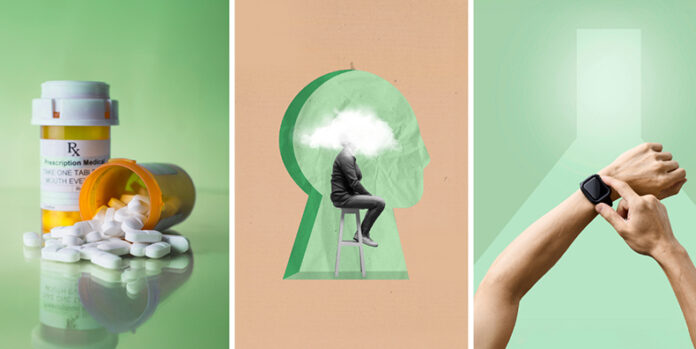
New studies on prescriptions that may reduce hospitalizations, how meds impact thinking, and the state of wearables for mood episode detection.
Key Takeaways
- When lithium isn’t enough, large real-world studies point to several medication combinations that may help lower the chance of needing a psychiatric hospital stay.
- Some bipolar medications are more strongly linked with brain fog than others, while lithium was not tied to worse thinking or memory in one study.
- Early research suggests common wearables like smartwatches might someday help spot mood episodes, but they’re not accurate enough yet to guide bipolar care on their own.
Like the rest of us, researchers studying bipolar disorder are trying to figure out how the latest technology can help them work smarter. Increasingly, that means crunching enormous amounts of data, sometimes with artificial intelligence (AI) and other advanced tools. These approaches excel at detecting patterns in huge data sets, the kind that might take a team of humans years and years to work through by hand.
Three new studies showcase some of the innovative ways researchers are harnessing large-scale data analysis to improve bipolar care, taking on these three questions:
- What can the hospitalization records of hundreds of thousands of people with bipolar disorder tell us about medication options beyond lithium?
- How can a trove of data on medications and thinking-and-memory tests reveal the potential link between those medications and bipolar brain fog?
- What can almost 1,400 days of mood and round-the-clock health tracking data uncover about whether wearables can detect bipolar mood episodes today?
When Lithium Isn’t Enough, What Comes Next?
Lithium has been the gold-standard bipolar treatment for decades. But it doesn’t work for everyone, and some people can’t cope with the side effects. When lithium falls short, what comes next can depend more on a prescriber’s judgment than on solid evidence.
A Nordic research team set out to give providers science to rely on. Their study, published recently in Nature Mental Health, followed more than 160,000 people with bipolar disorder in Sweden and Finland. The researchers analyzed how well various medications kept people out of the hospital.
This kind of study has a built-in challenge. When someone is hospitalized while taking a certain medication, is it because the drug isn’t working, or because people with the most severe symptoms tend to be prescribed that medication in the first place, making hospitalization more likely regardless of treatment?
The researchers got around this by comparing each person not with someone else, but with themselves: Looking at their odds of hospitalization during the stretches they took a medication versus periods they didn’t, over an average of about nine years. That type of analysis gets closer to understanding what a drug may actually be doing.
The researchers found that three prescription approaches lowered psychiatric hospitalization risk more than lithium alone:
- Clozapine (Clozaril) combined with aripiprazole (Abilify)
- Clozapine by itself
- Long-acting injectable antipsychotics paired with lithium
Among the roughly 20,000 people who had already stopped lithium, two combinations stood out as the most helpful for reducing hospitalizations: quetiapine (Seroquel) with lamotrigine (Lamictal) and olanzapine (Zyprexa) with valproate (Depakote).
An important caveat: Despite the large number of participants overall, hospitalizations were relatively uncommon across specific drug combinations, so more research is still needed to determine how widely these findings apply.
What This Means for You
- You have options after lithium. If lithium isn’t fully controlling your symptoms, or you can’t stay on it, your care team can draw on real-world data like this, showing which treatments helped keep other people with bipolar disorder out of the hospital.
- Combinations were among the strongest options. Several of the approaches that outperformed lithium paired two medications. If you’re on a single drug and still not getting the stability you need, these results suggest adding certain medications may be worth consideration.
- The findings are about hospital stays, not daily life. This study tracked hospitalizations, a marker of severe mood episodes, not the day-to-day symptoms you manage at home. This study doesn’t show how these medications affect the symptoms that make it more difficult to show up for work, relationships, and other everyday things that matter.
Could Your Bipolar Meds Be Fogging Your Thinking?
A lot of people with bipolar disorder feel like their thinking isn’t as sharp as it used to be, even when their mood is steady. And since nearly everyone with bipolar disorder takes some kind of medication, it’s common to wonder: Could the drugs be part of the reason?
To help answer that question, a Maryland-based research team studied 567 adults with bipolar disorder getting care in community clinics in the state. Everyone took a set of standardized thinking and memory tests. Then the researchers used a machine-learning tool to figure out which specific psychiatric medications were linked to lower scores, while accounting for factors that also affect thinking, such as symptom severity, education, and illness duration.
These findings, published recently in the International Journal of Bipolar Disorders, help clarify which medications are most likely to be associated with difficulty thinking. Overall, participants scored below average on tests of memory, attention, and visual-spatial skills. Out of 16 medications analyzed, three — ziprasidone (Geodon), clonazepam (Klonopin), and benztropine (Cogentin) — were each linked with worse scores. Benztropine showed an especially strong relationship, where the higher the dose, the lower the scores.
One medication was notably absent from this list: lithium. The drug showed no link to thinking problems at all in this study.
What This Means for You
- Brain fog is common, and medications may play a role for some. Many factors, including bipolar disorder itself, likely contribute to problems with thinking. Still, if you’re frustrated by your thinking skills, it’s important to bring it up with your provider, as these results suggest that tweaking your prescription plan might help.
- A few specific drugs may matter more than the rest. This study found links between lower cognitive performance with just three medications: ziprasidone, benztropine, and clonazepam. If you’re taking any of these and your thinking feels dull, it may be worth asking your provider about alternatives.
- For certain drugs, the dosage matters more than for others. The results suggest that higher doses of benztropine affect thinking more than lower doses. If you’re taking this medication and your thoughts feel sluggish, a dose adjustment may be worth discussing with your provider.
- Reassuring news if you’re on lithium. In this study, lithium was not linked to poorer thinking, as the researchers found no connection between lithium and thinking-and-memory test scores.
Could Your Smartwatch Predict a Mood Episode?
Biohacking is having a moment. Plenty of people — with or without a psychiatric condition like bipolar disorder — strap on smart watches and other devices to track heart rate, steps, and sleep, usually in the name of optimizing well-being and performance. But researchers have begun to wonder whether these commonplace wearables could have serious medical applications, including in bipolar disorder.
In this small pilot study, recently published in the Journal of Affective Disorders, a French research team investigated whether health data from Fitbits could detect mood episodes in 10 individuals with bipolar disorder, not only once mood symptoms had already started but also beforehand.
Ten participants wore Fitbits around the clock to record sleep, heart rate, heart rate variability, and step counts. To track their moods, they kept daily mood logs and met monthly with psychiatrists who used surveys and interviews to assess if they were in or about to have a mood episode. Researchers then used machine learning models to learn each person’s normal patterns and flag unusual changes as potential mood warning signs.
Among the participants, psychiatrists identified 15 depressive and 8 hypomanic episodes during the six months of the study. How did the models do?
The models weren’t perfect, but they were better than random guessing. They were reasonably good at using heart rate variability and step count to spot depressive episodes and a bit less effective at identifying hypomanic episodes using sleep and heart rate data. They could also pick up some changes in Fitbit data the days before a mood episode began, but this early-warning signal was the least reliable result.
This, again, was only a pilot study. It fits in with other research suggesting that there may be physical clues that a bipolar mood episode is approaching or underway, but the science isn’t settled on what those clues are or how to detect them. This study is meant to be a test balloon for the idea that the kind of wearables you might already have on your wrist could someday, with the right algorithm, be useful in spotting or predicting bipolar mood episodes. More and larger studies will be required before it’s time for any kind of clinical rollout.
What This Means for You
- Even for AI, catching is easier than predicting. Mirroring the present experience of many who live with bipolar disorder, the high-tech models were better at spotting a mood episode already underway than at seeing one coming. Likewise, the lead-up to depression was easier to read than the lead-up to hypomania.
- It’s not on your wrist yet. The fact that this is a 10-person pilot study and not a clinical trial reflects the current state of these technologies. If a wearable or an app claims it can predict your mood episodes right now, it’s wise to stay skeptical.
- Knowing your own normal is important. These models worked by learning participants’ baselines and watching for changes. That’s a good reminder that knowing your personal early-warning signs is a powerful way to help manage bipolar disorder.
Editorial Sources and Fact-Checking
- Esaki Y et al. Circadian Variability of Objective Sleep Measures Predicts the Relapse of a Mood Episode in Bipolar Disorder: Findings From the APPLE Cohort. Psychiatry and Clinical Neuroscience. April 24, 2023.
- Lieslehto J et al. Comparative Effectiveness of Treatment Strategies for Bipolar Disorder During and After Lithium Treatment. Nature Mental Health. April 23, 2026.
- Dickerson F et al. The Association Between Psychotropic Medications and Cognitive Functioning in Bipolar Disorder. International Journal of Bipolar Disorders. March 6, 2026.
- Pouchon A et al. Bipolar Disorder Relapse Detection and Prediction Using Smartwatches. A Pilot Study for Machine Learning Models Using Anomaly Detection Methods. Journal of Affective Disorders. August 15, 2026.