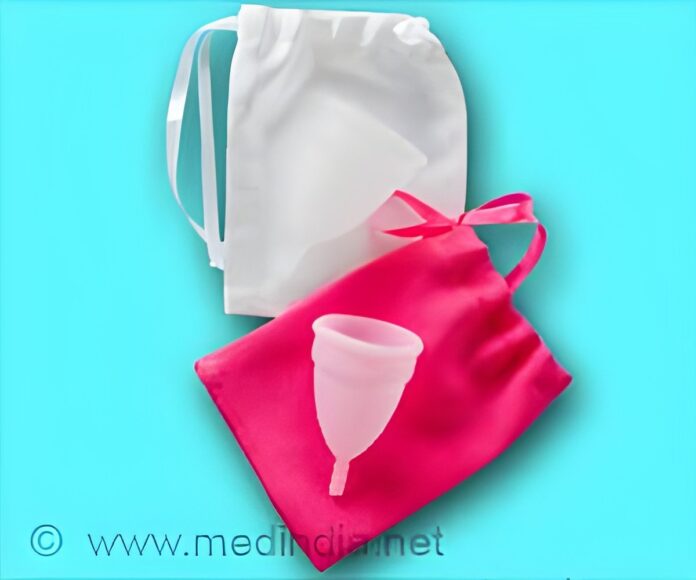
Modern features of menstrual cups such as silicone coating and fiber tablet help fight E. Coli and simplifies traditional sterilization methods.
Two new qualities of commercial menstrual cup were developed by scientists using silicone oil and seaweed fibers.
The menstrual cups coated with silicone oil repels E. coli (Escherichia coli), fostering hygiene improvement, while the plant tablet works as a good absorbent, providing spillage free period care. The use of fiber tablet also curbs the time-consuming traditional sterilization method of boiling. (1✔ ✔Trusted Source
Self-Cleaning Menstrual Cups with Plant-Based Biodegradable Superabsorbent Fibrous Tablets for Hygienic and Sustainable Period Care
Go to source
)
The next generation menstrual cup technologies were demonstrated by researchers from McMaster University. The study was published in study published in ACS Applied Materials & Interfaces.
“This research bridges advanced engineering and women’s health, creating a menstrual product that is not only self-cleaning and sustainable, but also opens doors for future health monitoring,” says Tohid Didar, one of the senior researchers of this study from McMaster University.
The Rising Demand for Sustainable Period Care
Nearly 2 billion people menstruate, and their desire for sustainable, reusable options — menstrual cups, discs and period underwear — is rising. Menstrual cups are designed to hold more fluid than tampons, allowing longer wear than the disposable option, and they can be cleaned and reused for years.
But users complain about unexpected spills during removal and the time-consuming process to sterilize the cups in boiling water or other sanitizing solutions — issues that can deter wider adoption of the products.
So, Zeinab Hosseinidoust, Didar and colleagues found a cup coating to reduce cleaning time and developed a tablet to absorb liquid inside the device.
Alginate Tablets for Spill Prevention and Biocompatibility
The researchers tested bacterial growth on three commercially available menstrual cups made from medical-grade silicone, finding that the cup infused with silicone oil repelled E. coli significantly better than the two other cups.
“And coating the outside of the infused cup with silicone oil helped keep blood from sticking, too. This result suggests that people only need to wash the coated cup with soap and water; no boiling is required,” says Didar.
Then, to create the absorbent tablet, they spun alginate (a polymer from brown algae) into fibers and linked them together with calcium chloride. The white, fluffy fibers clotted human plasma onto them within 16 minutes and neither inhibited nor promoted bacterial growth compared to a control (an empty petri dish without the plant-based fibers).
Scaling the Innovation from Lab to Market
The researchers say that this supports the fibers’ potentially safe usage in consumer products. In experiments, they formed the fibers into 1-gram tablets, and each tablet:
Soaked 15 milliliters of whole human blood (the capacity of the silicone-infused menstrual cup) over 8 hours.
Dissolved over four days in a water-based salt solution, breaking down into biocompatible compounds.
To prepare a proof-of-concept for commercialization, they also pressed and cut the fibers into teardrop-shaped tablets that fit inside the menstrual cups. Next, they will test the feasibility of mass-producing these alginate fibers, and the flushability of the liquid-soaked absorbent tablets.
“By making period care more accessible, hygienic and equitable globally, innovations like this have the potential to make a significant impact on women’s everyday health and well-being,” adds Hosseinidoust, a co-lead of the study.
Reference:
- Self-Cleaning Menstrual Cups with Plant-Based Biodegradable Superabsorbent Fibrous Tablets for Hygienic and Sustainable Period Care – (https://pubs.acs.org/doi/10.1021/acsami.5c16140)
Source-Eurekalert